

Easter 6, Year A
Psalm 66; Acts 17:22-31; 1 Peter 3:13-22; John 14:15-21
I.
This morning, I want to paint the picture of Athens as Paul saw it, when he went there to preach, as recorded in this morning’s reading from Acts 17.
It is a different picture from the one to which you are accustomed.
You are used to Athens being described as the seat of reason, logic, public debate, deliberation, and—most importantly in our American context—democracy.
The meetinghouse in which you now sit, our third meetinghouse, built in 1818, draws heavily on Athenian themes. The Corinthian columns.
This is not a meetinghouse that the original group of pioneer settlers would have felt comfortable worshipping in.
Like Paul, they would have said to their great-grandchildren, “I perceive that in every way you are very religious”—but they wouldn’t have meant it as a compliment.
Neither did Paul to the Athenians.
Acts 17:22 is a verse where the translator has to make a choice, and that choice gets in the way of the reader and the text.
This morning, we read verse twenty-two from the Revised Standard Version, a mid-twentieth century translation from Greek to English.
It reads, “So Paul, standing in the middle of the Areopagus, said: ‘Men of Athens, I perceive that in every way you are very religious.’”
Now hear this verse again in the older—many say the more reliable—King James translation from the seventeenth century: “Then Paul stood in the midst of Mars’ hill, and said, Ye men of Athens, I perceive that in all things ye are too superstitious.”
The modern translation makes the Athenians to whom Paul speaks sound, well, modern.
The older translation makes the Athenians sound more primitive—
not unlike the native populations Europeans had recently encountered—
within the last one hundred years—
when the King James Bible was translated.
It is this more primitive, superstitious picture of Athens that I want to paint for you this morning—
Because when we see Athens in this cruder light, she becomes much less reasonable.
She becomes a city—and a people—that are much more deserving of God’s judgment—indeed, who are already under God’s judgment—which is exactly how Paul sees them both.
II.
Both Paul and Peter, in the reading this morning from 1 Peter 3, are talking about God’s judgment.
They are talking about it in the context of two diasporas—two dispersions of two groups of people from their ancestral homes. That’s what diaspora means.
Peter is addressing the “exiles of the Dispersion in Pontus, Galatia, Cappadocia, Asia, and Bithynia”—Jews (and likely some Greek converts to Judaism) outside of Palestine.
Paul is addressing the Athenians, who, while they thought of themselves as Greeks, were—as Paul knew—descendants of that remnant of the human race descended from Noah, who re-peopled the world after the flood.
Peter is explicit about this in the reading this morning, at verse twenty, when he describes God’s patience “in the days of Noah, during the building of the ark, in which a few, that is, eight persons, were saved through water.”
That memory is important—even if the Athenians forgot—or chose to suppress it.
It is important because the worldwide event, the catastrophic flood, was God’s judgment on the ancient world.
Therefore, Paul’s observation in Acts 17:22, “Men of Athens, I perceive that in every way you are very religious” ought to be heard in the sarcastic, judgmental tone in which Paul says it.
Paul continues, “For as I passed along, and observed the objects of your worship, I found also an altar with this inscription, ‘To an unknown god.’ What therefore you worship as unknown, this I proclaim to you.”
We know from Paul’s letter to the Romans that Paul considers this altar to an unknown god to be a deliberate act of wickedness and suppression of the truth.
Paul writes in Romans 1:18 about the “men who by their wickedness suppress the truth.”
Certainly, he had the Athenians in mind. He had them in mind because, according to St. Paul, the Athenians were wicked men who suppressed the truth.
The Athenians built an altar to an unknown god not because they were genuinely curious, not from epistemic humility—a fancy way of saying, “We don’t know what we don’t know.”
They built their altar—not to a god they didn’t know—but to the God they were trying to forget.
They built their altar—not to a god they didn’t know—but to the God they were trying to forget.
And here Paul’s words—especially in the King James translation—convicted them: “Ye men of Athens, I perceive that in all things ye are too superstitious.”
Too superstitious.
All superstition is rooted in fear. Fear of the consequences you are trying to avoid—the pinch of salt thrown over your shoulder, avoiding a black cat, skipping the thirteenth floor on an elevator.
The Athenians’ altar to an unknown god was superstitious, because they could not forget the knowledge—buried deep within their racial memory—of the God who once judged them—and the entire human race—by baptizing the entire world in a flood.
After many generations, they succeeded in forgetting God’s name.
They could not escape the fear of God that Name put in them.
So, they built an altar to placate the God who continued to terrify their consciences, sending them dark dreams at night, speaking through ill omens, entrails, and oracles.
That is the picture of Athens I want to paint for you. That is the Athens Paul preached to.
That is Athens as she truly was, as the Bible reveals her to be.
And every time a government seeks to base itself on Athens—from Rome to Florence, from the American republic to the Paris Commune—whenever the Goddess of Reason seeks to suppress the God of Israel, Athens once again invites God to judge it.
Athens once again invites Paul to visit and say, “The times of ignorance God overlooked, but now he commands all men everywhere to repent, because he has fixed a day on which he will judge the world in righteousness by a man whom he has appointed.”
III.
Time and again men invite the Goddess of Reason into their courts while they suppress the knowledge of and efface the memory of the God of Israel.
Last week, Supreme Court Justice Neil Gorsuch did just that. In a New York Times interview with David French on May 6, Justice Gorsuch painted a picture of Athens—and America—that is quite at odds with how the Bible—and the God of the Bible—sees and will judge both.
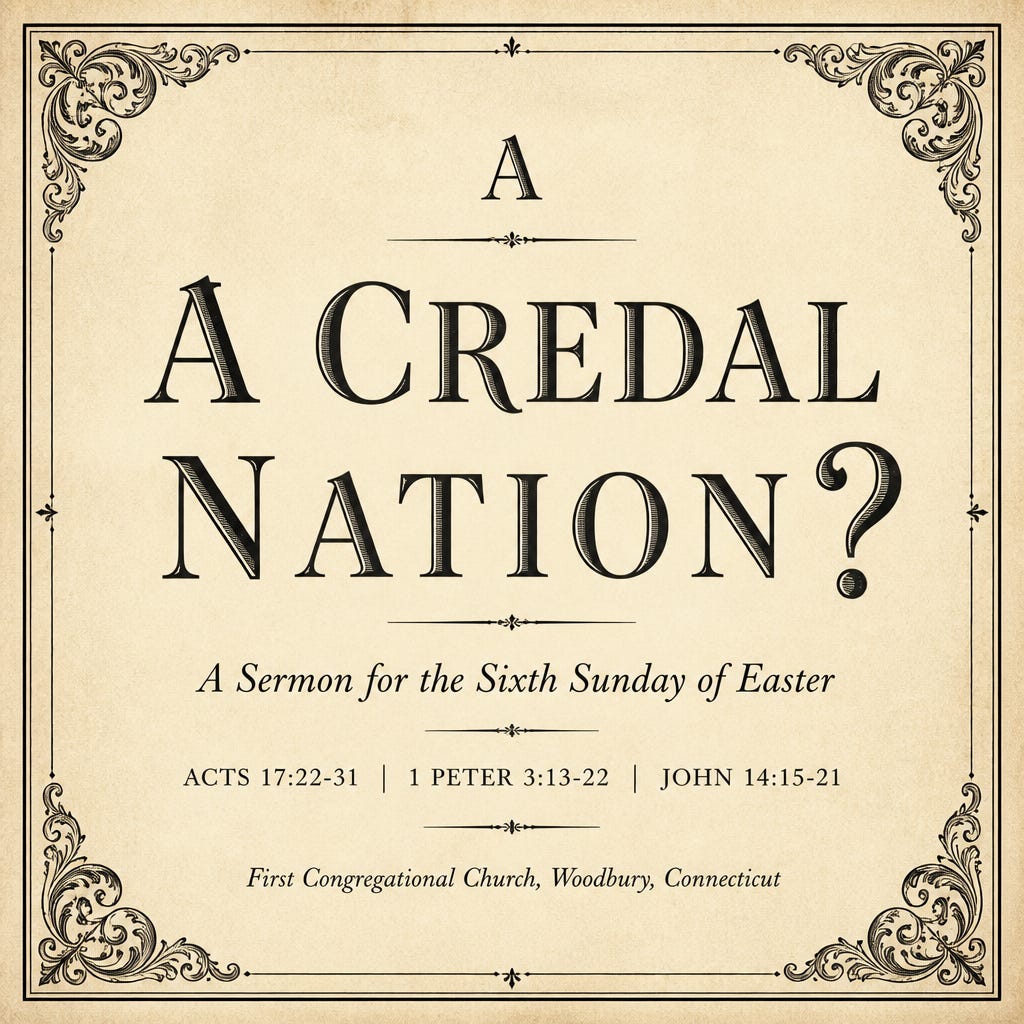
Gorsuch said in the interview, “we’re a credal nation, right, David? I mean, we don’t share a religion, we don’t share a race, we share an idea.”1
Gorsuch said in the interview, “we’re a credal nation, right, David? I mean, we don’t share a religion, we don’t share a race, we share an idea.”
“We share an idea.” Here, from a supposedly conservative, supposedly Christian, Supreme Court Justice, is a naked appeal to reason.
This propositional thinking may sound familiar to you. It may even sound very American to you, but then so was the Athenians’ altar to an unknown god.
How very Athenian that altar was. How very reasonable to name and honor every other god except the God whose Name is above all names.
How very American it can sound to say we share no religion—but that could only mean we share no god—and Paul calls Him in verse twenty-four, “The God who made the world and everything in it.”
That means God made America. He wills America into being every day. He has crown rights in America.
The patriots of 1776 rallied to the cry, “No King But Jesus!” Today’s godless liberals simply wail, “No Kings!”—meaning no kings at all—and certainly not King Jesus.
How very American it can sound to say we share no race, but that requires us to deny the God of whom Paul says in Acts 17:26, “[He] made from one [blood] every nation of men to live on all the face of the earth.”
Justice Gorsuch wants the idea of America without acknowledging the God of America.
Justice Gorsuch wants the idea of America without acknowledging the God of America.
That God made the nations and—according to Paul— “determined allotted periods and the boundaries of their habitation.”
That includes (it must be inferred from the text) the period and boundary of these United States.
Does not the text demand that we apply Paul’s words to our own time and place, to our own nation and people?
Yet Justice Gorsuch suppresses this knowledge and refuses to apply the biblical text.
He wears a black robe, as I wear a black robe, not because it is his right as a judge or mine as a minister, but because God Himself stands behind every minister and judge.
Ministers and judges wear the black robe because it is their sacred duty to defend the rights of God, not to pay lip-service to an idea.
An unknown god has no rights for his judges and ministers to defend. Neither does a naked idea.
IV.
Jesus does not ask us to press the rights of an unknown god. He does not ask us to live and die for an idea. He asks us to stand up for the truth.
God has rights. Truth has rights. But do we think of it that way?
We understand inalienable rights, property rights, the right to life, the right to bear arms. But what about the rights of God? The rights of truth?
Does not God have the right to be worshiped and obeyed by His creatures? Do we not rob God of that right when we skip church or offer worship that is not pleasing to Him?
Do we not—like the Athenians—try to forget the God we know from the Bible and substitute our own ideas instead?
Jesus says in this morning’s gospel reading from John 14:15, “And I will pray the Father, and he will give you another Counselor, to be with you for ever, even the Spirit of truth.”
If we have his Spirit of truth, do we not also have the right—and incur the obligation—to correct error and overturn falsehood?
In fact we do. That is what we see Paul doing in Athens—correcting Athenian superstition.
That is why I challenge Justice Gorsuch from this pulpit today.
This is why Peter says, “Always be prepared to make a defense to any one who calls you to account for the hope that is in you.”
But Jesus warns us what will happen when we try to do that. He says the world cannot receive the Spirit of truth, “because it neither sees him nor knows him.”
In other words, do not expect a warm welcome when you try to press God’s rights upon His creation by standing up for the truth.
This is the Father’s world. America is God’s country.
But even a conservative Supreme Court Justice can’t bring himself to say it.
That goes to show just how much the world—and her courts of law—neither see the Spirit of truth nor know Him.
Even conservative Christians aren’t saying what Scripture demands.
I pray Justice Gorsuch will know how the Truth suffered for him on the cross.
Jesus didn’t suffer and die for an idea. He suffered for a people.
He suffered for, as Peter wrote in last week’s lesson, “a chosen race, a royal priesthood, a holy nation, God’s own people, [so] that you may declare the wonderful deeds of him who called you out of darkness into his marvelous light.”
Justice Gorsuch, we don’t need you to tell us we are a credal nation only to add that the creed is merely a shared idea, not a common faith in the living God.
Justice Gorsuch, we don’t need you to tell us we are a credal nation only to add that the creed is merely a shared idea, not a common faith in the living God.
Peter knows that there is a price that Christians will have to pay for sticking up for this God—the God Gorsuch refused to name.
This is also why Peter tells us, “if you do suffer for righteousness’ sake, you will be blessed.”
Our American constitutional framework knows about rights. What it has forgotten is whose rights matter most.
God’s rights matter. That is why Jesus must ascend, so that the Spirit of truth can descend.
He goes to claim His crown above.
His Spirit-filled church remains below to press His crown rights.
V.
Now we, as Christ’s church, as His covenant people, must press His crown rights in America. What does that look like?
First, it looks like what Paul told the Athenians in Acts 17:30, “The times of ignorance God overlooked, but now he commands all men everywhere to repent.”
For several generations now America has forgotten the God of her fathers—and God has graciously overlooked our willful ignorance.
No more. Now is the time of repentance. Why? Because, as Paul continues in verse thirty-one, “because he has fixed a day on which he will judge the world in righteousness by a man whom he has appointed, and of this he has given assurance to all men by raising him from the dead.”
Easter—the resurrection—
is our assurance that God will soon judge us—
not according to an idea—
but by a man—Jesus—
whom He has appointed to be our judge.
So, pressing King Jesus’ crown rights means doing what Paul did.
We must challenge the altars of willful ignorance in our government, media, churches, schools, amusement parks, and banks.
We must challenge them within our families and among our friends. And we must call them to repentance.
You may ask: do I really have to do this? Do I really have to close my bank account at Ion Bank because they support Pride in the Hills or skip Quassy this summer for the same reason?
Because these are the altars, right?—the Athenian altars of today.
Put it that way, and you see them for what they are: robbery, the theft of God’s honor and of what is owed to Him.
Paul could see it. Peter could see it. The early church could see it. Do you see it?
Our founding fathers left us the framework—the covenant framework—that we need to press the crown rights of heaven here on earth.
This isn’t an idea. This isn’t an abstraction. It’s a matter of law.
This is why I know a justice like Neil Gorsuch knows better. In fact, his rulings generally suggest that he does.
But this idea that America is an idea and not a nation under God is pernicious and has worked its way into the thinking of the very best of us.
On Friday evening, I was on the panel at a debate between two candidates for governor of Connecticut, Ryan Fazio and Betsy McCaughey.
I asked them what they would do to promote Christianity, the religion of Connecticut’s founding and woven into her history ever since. They didn’t answer the question.
The answers they did give would have made perfect sense to the Athenians—Americans have the right to worship any god or no god at all.
Neither candidate mentioned God’s right to be worshiped by a free and regenerate people.
I asked them if they would use their constitutional powers to shut down churches that promote “practices inconsistent with the peace and safety of the state” or “excuse acts of licentiousness.”
Again, both balked.
It is very hard for Americans—
including those running for public office—
who have been weaned on the notion that America is merely a proposition, an abstraction, a shared idea—
to come to terms with—
let alone to fulfill—
the requirements of God’s covenant.
A covenant that stipulates—
as Paul reminded the Athenians—
that God “gives to all men life and breath and everything. And [that] he made from one every nation of men to live on all the face of the earth”—
including our nation and the men and women who live in it today.
How do we reclaim this covenant understanding of ourselves—
that we are a people who share God, not the idea of god—
that the idols of false religions—
of Hindu deities or the Buddha—
no more belong in America than they do in India or Tibet?
Hear what I am saying. Pay close attention.
Not only am I saying that false religions do not belong in the United States, I am saying they do not belong even in the countries from which they come.
The idols of Krishna and Ganesh do not belong in New Jersey, Ohio, or Texas any more than they belong in Calcutta, Benares, or Bombay—
which is to say—
they don’t belong anywhere.
They do not belong in India; they do not belong in the United States.
“That is a horrible, intolerant, and probably racist thing for you to say, Pastor!”
“I am going to petition the IRS to take your tax-exempt status away.”
So be it. Dismiss me. Ignore me. Call me unfit for polite society. Defrock me. Run me out of town on a rail.
Paul told the Athenians in Acts 17:29, “Being then God’s offspring, we ought not to think that the Deity is like gold, or silver, or stone, a representation by the art and imagination of man”—
So, I guess you’d better run St. Paul out on a rail too. Would Paul be welcome in Woodbury?
Would he be welcome in Connecticut?
Paul continues in verse thirty, “The times of ignorance God overlooked, but now he commands all men everywhere to repent.”
That means that it’s time for the Hindus to destroy their idols. They can’t bring them to America.
It’s time for the Muslims to smash their crescents. They can’t come here and replace the cross.
It’s time for the Muslims to smash their crescents. They can’t come here and replace the cross.
That means it’s time for the Catholics to destroy their statues, and the Orthodox their icons.
The idols of every nation and religion must come down.
That means it’s time for Protestants—
meaning all Americans—
to recapture their institutions—
not just Harvard, Princeton, Yale, and the mainline churches—
but also the institutions of self-government: the town meeting, the statehouse, and the three branches of our federal government.
It is a long way back. Both the gubernatorial candidates I heard Friday evening do not understand the covenant. But I am convinced they are teachable.
But I can’t do it alone. Write to them. Send them this sermon. Tell them you go to this church. Explain the covenant to them and its obligations.
To hold a position of authority, be it governor, senator, selectman, or dog catcher, is to hold a covenant position.
To operate a bank or even a family amusement park is to lay claim to the public trust.
Whether the people holding these positions understand it or not, it remains true. They are officers of the covenant.
Your job is to help them understand this, and the consequences for breaking His covenant: God’s judgment.
Men in black robes like the one I’m wearing preached the American Revolution from pulpits like this one, but they also led congregations of regenerate men and women.
Prove yourselves to be regenerate—God’s offspring—the adopted children of God.
Gain the assurance of a clear conscience that comes from being zealous for what is right—even if it costs you.
Preached on May 10, 2026, at the First Congregational Church, Woodbury, Connecticut (https://www.firstchurchwoodbury.org).
David French, “Justice Neil Gorsuch on the ‘Miracle’ of Agreement on the Court,” interview with Neil Gorsuch, The Opinions (podcast), New York Times, May 6, 2026, https://www.nytimes.com/2026/05/06/opinion/neil-gorsuch-america-250-supreme-court.html.


