

Lent 3
Psalm 95; Exodus 17:1-7; Romans 5:1-11; [1 Corinthians 10:1-4]; John 4:5-42
You can also subscribe to this podcast on Apple, Spotify, or YouTube.
I.
I would like to draw your attention this morning to these ungrateful words of apostate Israel: “Why did you bring us up out of Egypt, to kill us and our children and our cattle with thirst?”
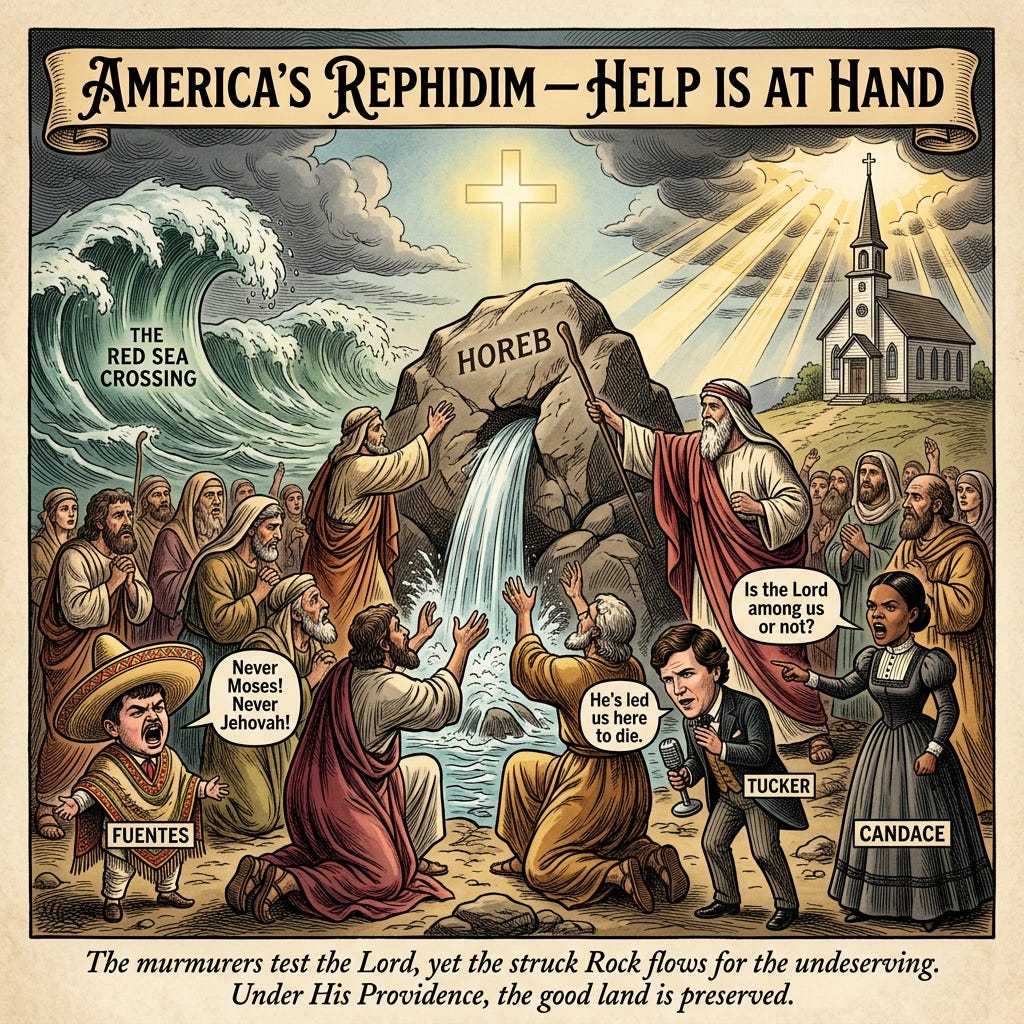
Exodus 17:1 tells us these faithless words were uttered after the congregation moved on from the Red Sea — which they had just miraculously crossed on dry land — and came to camp at Rephidim, where there was no water for the people to drink.
Their need is pressing, their thirst is real, and now faithless people put God to the test by asking: “Is the Lord among us or not?”
Ten plagues upon the Egyptians were not enough to convince them that He was.
The Angel of Death killed the firstborn of Egypt — man and beast — but passed over Israel untouched. They were shielded by the blood of the Lamb. Yet this left no impression.
The drowning of Pharaoh’s armies inspired no trust.
And so they grumble and murmur: “Why did you bring us up out of Egypt, to kill us and our children and our cattle with thirst?”
Like the Israelites of old, too often the Church — to say nothing of the shell of Christian culture that America has become today — grumbles and murmurs, doubting the good God who has brought us this far.
Both Church and Society have reached their Rephidim — our place of obvious and pressing need — only to say we lack the resources to go any further, only to ask, “Is the Lord among us or not?”
It seems too much — more than we have in us — to restore our churches to biblical faithfulness, too much to restore our republic to something like the godly order our Founders intended.
We can’t even visit long-overdue vengeance on an enemy that humiliated us 47 years ago without having to listen to a chorus of treacherous murmuring.
What we fail to see — because we fail to read or take the Old Testament seriously — is that the history of God’s people then is a template for God’s people now.
We have been to Rephidim before. We have tested God before. He has proved faithful.
Why do we continue faithless?
II.
Let’s take a closer look at what happened at the Israelite camp at Rephidim. See if you can’t recognize a pattern here that recurs in both the institutional life of the Church and personally, in the lives of Christians.
We are looking at Exodus 17. A quick recap of recent events in the story is in order. In Exodus 14, God led the Israelites out of Egypt on dry land. In Exodus 16, He fed them with manna bread from heaven. Now, at Rephidim, God gets water from a stone — literally.
The key point is that at Rephidim help was found in unexpected places and given in unexpected ways.
As Exodus 17 begins, the Israelites move on from the wilderness by stages, making camp in a place where there is no water.
The people find fault with Moses saying, “Give us water to drink.”
Moses warns them that finding fault with him is no different than finding fault with God: “Why do you find fault with me?” Moses asks. “Why do you put the Lord to the proof?”
In other words, why are you testing God?
The situation escalates quickly, becoming dangerous. Moses cries to God: “What shall I do with this people? They are almost ready to stone me.”
God replies that Moses is to go on ahead of the people, taking some of the elders with him, and “the rod with which you struck the Nile,” to the rock at Horeb.
There, Moses is to strike the rock with the rod and “water shall come out of it, that the people may drink.”
These undeserving people are refreshed by God’s grace.
I said before that the point of the Rephidim story is that help was found in unexpected places and given in unexpected ways.
Fair enough. Getting water from a stone is unexpected, but then so is the parting of a large body of water and the provision of bread from heaven. At this point in Israel’s story, why should anything God provides them seem unexpected?
Creation itself might seem unexpected — God’s speaking things into existence equally implausible — if not for the fact we find ourselves planted in the middle — and part of — creation.
Yet too often our response, like the Israelites, is to murmur, to find fault with our leaders, certainly with God Himself, asking: “Did you create us just to destroy us?”
But the fault is not in God or in our stars, but in our moral compass, which is broken.
III.
That compass is shattered by doubt — a sinful, rebellious doubt — that God is who the Bible says He is.
Despite God’s continuing preservation by providence, we doubt that He will continue to sustain us.
Rephidim means “rests,” “stays,” “supports,” or “refreshments” in Hebrew — this is the place the Israelites come to from the wilderness — yet, by the end of the story, the place is called Massah and Meribah, the place of testing and contending with God.
This is why only Moses, along with some (not all) of the elders of the people are invited to go to Horeb, to witness the striking of the rock and the miracle that ensues.
God’s providence should be expected by now — miracles should be expected — but few, if any, including Moses and the elders, understood this yet.
No one — not the people of Israel, not their elders, not even Moses — no one deserves the miraculous water from the rock.
Like the blessings of land and protection promised to Abraham that I preached on last week, this miracle is given, not earned.
The murmuring, the testing of Moses and God, is the blatant attempt to earn God’s blessing, to earn God’s grace, to force the miracle, to bend the arc of providence to the people’s will. In other words, it is an act of rebellion.
In Exodus 17:3 the people try to put God in their debt “Why did you bring us up out of Egypt, to kill us and our children and our cattle with thirst?”
They are, in effect, saying, “If you led us out here to die, then make a quick end of it, but if not, then you, God, you owe us!”
In Exodus 17:7 the people demand proof — visible proof — proof reserved for Moses and a few elders only, that the Lord is with them. “Is the Lord among us or not?” they ask.
But most of them were not invited to see the Lord, standing on the rock at Horeb.
Only Peter, James, and John were invited up the mountain to see Jesus transfigured, and while many saw the Risen Lord, it was by no means everyone, certainly not everyone who saw Him crucified.
IV.
That is because no one deserves to see the Lord. No one has a right to a personal encounter with Jesus, least of all the Samaritan woman, who encounters Him at a well by chance, as we read in this morning’s gospel.
Of course it’s not an unexpected encounter. We should be expecting the unexpected by now. This moment was created by God and brought about because He governs His creation.
The woman did not perceive any of this. Her race and her religion kept her in the dark about such things.
John 4:10 is an indictment of her Samaritan ignorance. Jesus says: “If you knew the gift of God, and who it is that is saying to you, ‘Give me a drink,’ you would have asked him, and he would have given you living water.”
Jesus uses similar words in the next chapter to indict Jewish ignorance: “If you believed Moses, you would believe me, for he wrote of me” (John 5:36).
You see, it is possible to be ignorant — culpably ignorant of God’s word — and to miss Him entirely.
But the woman has a rudimentary faith — proof that some things are hidden from the wise and revealed to babes — or, in this case to a woman with five previous husbands.
I said last week that the Jews were the first Christians — the first to believe that there is a Messiah — that the Messiah is even a thing — based on a promise that went back to nearly the beginning of their race, to a time well before the Samaritans and Jews became rivals, and the hostility we see playing out between the Jewish Jesus and the Samaritan woman existed.
Therefore, the woman can witness to her faith in the old promise of God. She says in verse 25, “I know that Messiah is coming (he who is called Christ); when he comes, he will show us all things.”
To which Jesus replies with these unexpected words, “I who speak to you am he.”
With those seven words the woman’s status is raised. She is permitted to see what angels have longed to see (1 Peter 1:12).
She is invited — like one of the select elders of Israel — to go with Moses and see living water struck from the rock at Horeb.
But now we are no longer on Mount Horeb. We are not even at the well, outside a city in Samaria, near the field Jacob gave his son, Joseph.
John, in his mystic style, is foreshadowing events to come in Jerusalem: “Woman,” Jesus says to her, “believe me, the hour is coming when neither on this mountain nor in Jerusalem will you worship the Father.”
Jesus continues: “You worship what you do not know; we worship what we know, for salvation is from the Jews.”
Salvation happens in a very unexpected way — unexpected if you haven’t studied your Old Testament. The rod of divine justice strikes the Rock.
“The Rock was Christ,” Paul tells us. (1 Corinthians 10:4), crucified for our sake on a Roman cross, where not only living water, but saving blood flows freely from it.
Now, the invitation is no longer to a few elders, to a few disciples, or even to a single Samaritan woman, but to the whole world:
“For God so loved the world that he gave his only Son, that whoever believes in him should not perish but have eternal life” (John 3:16).
V.
I began by saying God’s people have been to Rephidim before. We have been to Rephidim before.
Scripture chronicles many episodes, culminating at the foot of the cross — truly the most unexpected means of help and relief.
Having been here before, having seen how God provides, why do we continue faithless? Why do we murmur against God?
Let me speak plainly. We are Americans. We are sons and daughters of the American Revolution. Ordered liberty is our birthright. We are heirs to the Protestant Reformation. Our rights are given to us by the God of the Bible, not the King of England, the Pope of Rome, or the Governor of Connecticut.
This American genius, call it the Spirit of ‘76, call it the hand of a benevolent Providence, converts all who come to these shores.
To be American is to be a Protestant Christian — even if your personal creed is something else — even if you privately worship a false god, or practice a less-than-biblical form of Christianity.
Publicly, our institutions are Protestant because they are rooted in biblical law.
They are the institutions of free-born, regenerated men.
They were forged in the crucible of the Continental Reformation and the English Civil War.
They were perfected in the New England wilderness.
God in His mercy has used this Protestant inheritance to call people from every nation to Himself.
Not every American needs to confess this faith, to subscribe to the Westminster Confession or the Thirty-Nine Articles, but every American must conform to the laws and aspire to the standards derived from this faith, from the Protestant Reformed religion.
Not every American needs to confess this faith, to subscribe to the Westminster Confession or the Thirty-Nine Articles, but every American must conform to the laws and aspire to the standards derived from this faith, from the Protestant Reformed religion.
This is a call to public righteousness, not forced conversion.
Until the 1960s both immigrant and native-born cultivated and practiced a high civic virtue that defined what it meant to be an American.
I am thinking of two men of the 20th Century who exemplified this Protestant standard in public life.
Dwight Eisenhower, who was baptized in the White House by a Presbyterian minister, and John F. Kennedy, a Roman Catholic.
Yes, the Roman Catholic president very much conformed himself publicly to this Protestant — to this American — standard.
Professor George Marsden, a leading historian of American religion, called this the “Anglo-Saxon Protestant moral consensus” which, he writes, “became synonymous with culture, ‘values,’ and right living.”1
That all changed after Kennedy was assassinated. It was then we started murmuring.
Why do we now murmur against God? Why do we fear the challenges of the hour? Why do we murmur against a president who has the courage to face and fight our enemies, both foreign and domestic?
It is because, like the Israelites, we put the Lord to the proof by saying, “Is the Lord among us or not?”
He has not given us this nation and secured our liberty in blood? Yet we ask: Is the Lord among us or not?
He has not guided us these 250 years? Yet we ask: Is the Lord among us or not?
Does He not continue to call this First Church of Woodbury, Sunday after Sunday, for the past 355 years? Yet still we ask: Is the Lord among us or not?
Are we living in perilous times? We most certainly are. Have we made it safely to this day? Yes, we have.
We face a mighty task. God is asking us to build His kingdom and take back what the Enemy has stolen.
God brought us up out of Egypt, from the bondage of our sins. His Son died to give us eternal life, not to destroy us.
If you’re tempted to think otherwise — and we all are — remember: we’ve been here before. We’ve been to Rephidim before.
Now, we are here once again, facing spiritual, if not physical, hunger and thirst, only this time let us not murmur. Let us have no quarrel with God.
We must not contend with Him but for Him. We must take His side in this fight, for He has already taken ours.
We’ve been to Rephidim before, but now we’ve also been to the mountaintop. We’ve seen Him transfigured. We’ve met Him at the well, and at the cross, where He died to refresh us.
Let us thank the divine Providence which brought us to this hour. Let us not second guess it.
There is a plot taking shape against this country. Many are duped into thinking it’s orchestrated by “the Jews” or to benefit Israel.
But America fights her own battles. Old adversaries have recently learned that though it may take a generation, America will answer. Newer adversaries are paying close attention.
Our murmurers are home-grown. Fuentes, Tucker, and Candace are to us what Korah, Dathan, and Abiram were to the Israelites (Numbers 16).
They sow doubt, and doubt leads to rebellion.
America is worth defending, which means her Protestant soul is worth fighting for, her Reformed doctrines worth recovering, so that we can teach them, once again, to our children.
You will be told otherwise. You will be told that the Reformation is the reason for the liberal mess we’re in now. You will be told that you are “too smart” to be Protestant.
This is sloppy thinking. Those who say it are disloyal. They find fault with Moses and put the Lord to the test.
America, you have come again to your Rephidim. You have been here before. Do not listen to those who lead you to strange altars.
God has given you a good land, and the lamp of His word by which to govern it and continue in prosperity. Stop murmuring and continue the conquest of this new Canaan.
Preached on March 8, 2026, at the First Congregational Church, Woodbury, Connecticut (https://www.firstchurchwoodbury.org).
George M. Marsden, Fundamentalism and American Culture: The Shaping of Twentieth-Century Evangelicalism, 1870–1925 (New York: Oxford University Press, 1980), 114.


