

Lent 4
Psalm 23; 1 Samuel 16:1-13; Ephesians 5:8-14; John 9:1-41
You can also subscribe to this podcast on Apple, Spotify, or YouTube.
I.
The problem is: Our gospel lesson this morning from John is divided neatly into three parts: (1) the miracle of a man blind from birth receiving his eyesight, (2) the investigation of the miracle, the trial, and the excommunication of the man by the Pharisees, and (3) the verdict of this kangaroo court is overruled by Jesus.
In John 9:2, Jesus’ disciples ask, “Rabbi, who sinned, this man or his parents, that he was born blind?”
The disciples have the words of Exodus 20:5 in mind, which reads:
“for I the Lord your God am a jealous God, visiting the iniquity of the fathers upon the children to the third and the fourth generation of those who hate me.”
This verse from Exodus establishes the biblical basis for collective punishment and generational sin.
But the Bible does not stop there. Ezekiel modifies this in 18:20, saying, “The soul that sins shall die. The son shall not suffer for the iniquity of the father, nor the father suffer for the iniquity of the son.”
But the Bible does stop there. Ezekiel modifies this in 18:20, saying, “The soul that sins shall die. The son shall not suffer for the iniquity of the father, nor the father suffer for the iniquity of the son.”
This modification became very important during the Black Lives Matter riots, the Summer of Love of 2020, and the “mostly peaceful protests” — which resulted in insured losses of at least $1-2 billion, if not more.
It became important because it was then that Americans got their first dose of Maoist-style, collective punishment rhetoric.
America, particularly white Americans, were held collectively responsible for something called “systemic racism.”
Everything from mathematics to showing up to a meeting on time became emblematic of “white privilege,” something we were told must be disavowed.
It was a time of fear, of mask mandates, and of social distancing.
For once, we experienced sin the way the Bible describes it, as something inherited, something we weren’t personally responsible for, as something that can pollute us, just by coming into contact with it.
In 2020 and 2021 all of us could finally understand what it meant to be called unclean.
If you can remember what that felt like in 2020 and 2021, during a reign of racial and medical terror, then you will understand better the disciples’ question to Jesus: “Rabbi, who sinned, this man or his parents, that he was born blind?”
What is harder to understand is Jesus’ answer: “It was not that this man sinned, or his parents, but that the works of God might be made manifest in him.”
This man was born blind so that Jesus could heal him.
II.
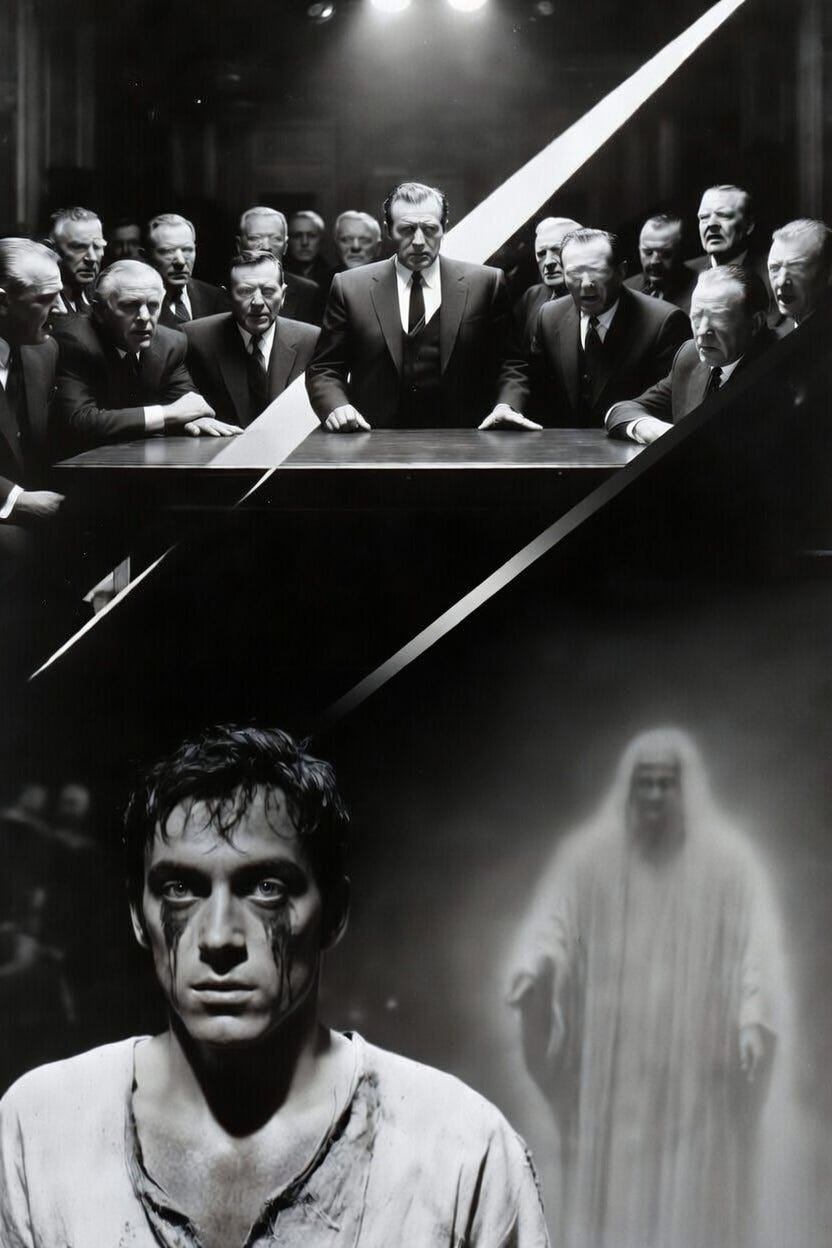
Very well, let us turn now to the investigation of the miracle and the trial of the man by the Pharisees.
It is likely that the trial was conducted by the Jewish council, the Sanhedrin.
We know this because in verse 34 they “cast him out” — they excommunicate the man from the synagogue.
This is what the man’s parents were afraid of themselves. John tells us in verse 22, “His parents said this because they feared the Jews, for the Jews had already agreed that if any one should confess him to be Christ, he was to be put out of the synagogue.”
This is a show trial — a flex — a move by the Sanhedrin to terrorize the Jewish faithful, to show them who’s boss.
Say the name of Jesus and you will be thrown out of the Jewish Church, out of the synagogue.
This is likely what the man was turned in by his neighbors.
Did you catch that in verse 13?
It reads: “They brought to the Pharisees the man who had formerly been blind.”
Why would they do that? Out of fear. Like faithful Christians living under the terror of the Spanish Inquisition, or even in our own day, how many of us are afraid to speak out? To speak our minds?
Perhaps we are not so bad — yet — as to turn our neighbors in, but we are getting there. The things I say and preach are routinely reported.
I had to spend an hour last Monday afternoon on a Zoom call explaining to the Conference Minister of the Conservative Congregational Christian Conference a tweet I posted in which I said that I would not recommend Democrats for membership in this church.
Someone online reported me. To the “Sanhedrin,” if you will. To “the council.”
Why? To try to silence me. To shut me up. To strike fear into my heart.
But as your pastor it is my duty to defend this flock. That starts with making sure some people never join it.
The Jews of Jerusalem lived under a fearful regime, a regime propped up by its informers and spies.
However, when the man is healed and his eyesight restored, the fear starts to lose its grip — at least on him.
It loses it long enough for him to speak the truth, the truth about who healed him.
His concerned neighbors — who are, it seems, more concerned for their own safety than thankful for his healing — ask: “how were your eyes opened?”
Without hesitating the man replies, “The man called Jesus!”
Yes, John writes something about spit, and mud, and washing in a pool with an evocative name, but the blind man is emphatic: It was “The man called Jesus!” who gave him his sight.
There can be no question or doubt. Jesus healed this man, and the man’s confession, his speaking the Name of Jesus, strikes fear into the hearts of the man’s neighbors, fear of the council, fear of the inquisition.
So they turn him in to the council. John writes: “They brought to the Pharisees the man who had formerly been blind.”
The council then proceeds with a trial. It is worth pointing out two things about this trial.
The first is to point out that when John uses the word Jews, he is not talking about all of the Jews or even every member of the Pharisees or the Sanhedrin.
In fact, there is dissent in the council. John 9:16 tells us “There was a division among them.”
“Some of the Pharisees said, ‘This man is not from God, for he does not keep the sabbath.’ But others said, ‘How can a man who is a sinner do such signs?’”
The second thing to point out is how well-attested this miracle of Jesus is. Scoffers, men of “science,” evolutionists, modernists, they all reject the miracles of Jesus. To a man they say, “Show me the proof!”
Well, here is the record of an investigation and trial, complete with eyewitness testimony of the highest calibre — the man’s parents.
They testify in verse 20, “We know that this is our son, and that he was born blind.”
Here we must choose: trust the science or trust the scriptures? Does the Bible lie or tell the truth?
Scoffers, men of “science,” evolutionists, and modernists all say this story is made up, that there was never any such blind man, and that certainly there was no miracle.
They will say that maybe John wanted to call our attention more generally to our spiritual condition, to our blindness to the suffering of those around us, to our turning a blind eye to systemic injustice.
That’s the way this passage is preached in progressive churches: that Jesus is dealing only with spiritual blindness, blindness of the heart.
Jesus is dealing with spiritual and heart blindness, but He really did give a blind man his physical eyesight.
If the story is true, then here is all the forensic evidence we could ask for — the testimony of the parents — who were terrified at having to give it in the first place.
Parents who, it seems, would rather their son remained blind, than have to admit in a court of law that Jesus had cured him.
Moreover, this is the record of a hostile court, and a court that comes to an irrational judgement.
The judgment is that that man was born in “utter sin,” the evidence for which is that he was blind from birth.
But the man on trial before the council can see, and if he can see, then either he has been healed or he was not born in utter sin.
Somehow the court convicts, and casts him out of the synagogue.
I think we have some of the descendants of these judges sitting on the bench today. A ruling last week from the Ninth Circuit Court of Appeals comes to mind.
This shows us what the response of the unbelieving world is to anyone — including any one of you — anyone who might dare to speak up, who might dare to say, “The man called Jesus saved me.”
Unbelievers cannot accept the record even from a court whose verdict was swayed by their fellow unbelievers.
This makes clear one of the primary purposes of God, one of the primary ways in which the word of God works. It works by separation.
The very first act of creation is an act of separation.
Genesis 1:3-4 tells us, “And God said, “Let there be light”; and there was light. And God saw that the light was good; and God separated the light from the darkness.”
In the same way, this man was born in darkness so that “the works of God might be made manifest in him” — so that he might be separated from the kingdom of darkness and transferred to the kingdom of God.
Jesus says, “We must work the works of him who sent me, while it is day; night comes, when no one can work.”
Someday, perhaps someday soon, God’s work of separation will be complete.
On that day those of us, like the man born blind, who can say, “The man called Jesus saved us,” we will sit in judgment on the courts which once judged us.
III.
Genesis 1 tells us that “darkness was on the face of the deep” and that the light was separated from it. The man is born blind so that Jesus one day might separate him from the darkness and bring him to the light.
Sometimes, God acts quickly, as He did on the first day of creation. Sometimes, we wait many years before God’s plan becomes clear.
The lesson for us is that we must be ready to act when God moves.
In today’s reading from 1 Samuel 16, God was ready, but Samuel was still grieving.
In verse 1 God says, “How long will you grieve over Saul, seeing I have rejected him from being king over Israel? Fill your horn with oil, and go; I will send you to Jesse the Bethlehemite, for I have provided for myself a king among his sons.”
God is ready to move on, but Samuel is still wallowing in disbelief. He had anointed Saul to be king, but God had rejected Saul.
The coming of Jesus meant that God was ready to reject Jerusalem, reject the temple, reject the Pharisees and their kangaroo court.
He’s offering them their freedom, but the blind man’s neighbors can’t see it. They are spellbound by fear. They are still in lockdown. They are still wearing masks — not over their mouths — but over their eyes.
St. Paul tells us in this morning’s reading from Ephesians to “walk as children of light” and “Take no part in the unfruitful works of darkness, but instead expose them.”
This is a warning for Christian believers not to be like the blind man’s neighbors, in fact, not to be like unbelievers at all.
The unbeliever acts from fear, but believers are asked to do courageous things.
Paul writes, “Therefore it is said, ‘Awake, O sleeper, and arise from the dead, and Christ shall give you light’” (Ephesians 5:14).
Once we’ve been given that light, that is, once we’ve been separated from the darkness, there is no going back.
Having seen Christ, having gazed upon the truth, it is impossible to unsee Him.
What holds us back? Are we grieving someone like Samuel grieved Saul? Some old version of America, Connecticut, or even ourselves? (See: A Glimpse Of Connecticut 1960s, America’s Fallen Cities: Hartford.)
IV.
Having been “cast out” the man has nowhere to turn.
Having been separated from the darkness of the unbelieving council, he has not yet come into the light. It is in this moment that Jesus seeks and finds him.
“Jesus heard that they had cast him out, and having found him he said, “Do you believe in the Son of man?’ He answered, “And who is he, sir, that I may believe in him?’ Jesus said to him, ‘You have seen him, and it is he who speaks to you.’”
The blind man responds, “‘Lord, I believe.’” John tells us he then proceeded to worship Jesus.
Jesus concludes this episode with these astonishing words, “For judgment I came into this world, that those who do not see may see, and that those who see may become blind.”
Sometimes, we wait many years, many centuries, for God to act. But now the Messiah has come, and the proud get what they deserve.
John continues in verse 40, “Some of the Pharisees near [Jesus] heard this, and they said to him, ‘Are we also blind?’”
The next words Jesus speaks reverse the council’s verdict. They place the guilt on them: “Jesus said to them, “If you were blind, you would have no guilt; but now that you say, ‘We see,’ your guilt remains.”
The Pharisees’ spiritual blindness remains, and with it, their guilt.
Motivated by a guilty conscience, Pharisees of every age convene their unjust councils and cast out every believer they find.
The good news is: they drive us to Jesus. What they intend for evil, God uses for good. Excommunication from their assembly is a prerequisite for membership in Christ’s church!
Paul writes, “for once you were darkness, but now you are light in the Lord; walk as children of light” (Ephesians 5:9).
V.
Let me conclude by drawing your attention to two points I touched on earlier.
The first thing to draw your attention to are these awe-inspiring words of Jesus: “For judgment I came into this world, that those who do not see may see, and that those who see may become blind.”
The story that began with the question, “Who sinned, this man or his parents?” ends with “For judgment I came into this world.”
From this we learn that sin cannot be minimized, it must be — and will be — judged. Jesus doesn’t negotiate. He judges.
We learn that collective guilt, collective punishment is real. The world is under judgment.
But we also learn that God acts to save us one by one, just as Jesus sought this blind man specifically, yet we cannot be saved apart from Christ. Collective salvation is real.
There are, in fact, two entirely separate kingdoms, two different destinies. This is why the doctrine of the visible church is so important.
Your membership in this church is a visible sign of your salvation. You join as an individual. You are saved as a church.
This is why I say Democrats, Communists, Fascists, satanists, homosexuals, adulterers, fornicators, idolators, witches, atheists, modernists, and liberals — anyone who is part of some other collective and who refuses to repent of it — cannot be allowed to join Christ’s collective, Christ’s church.
People are offended when I say this. Let me read to you what Circuit Judge Lawrence VanDyke wrote in his dissent to the 9th U.S. Circuit Court of Appeals ruling upholding the right of men to use the ladies’ changing rooms in Washington State spas.
Using explicit language for the male member in his dissent he writes, “You may think that [redacted] shouldn’t appear in a judicial opinion. I hope we all can agree that it is far more jarring for the unsuspecting and exposed women at Olympus Spa — some as young as 13 — to be visually assaulted by the real thing.”
You may think preachers shouldn’t be so explicit about who can call himself a Christian, but the believing members of the church — some of them quite young — find it far more jarring to find they’ve been infiltrated by unbelievers while their pastor says nothing about it.
VanDyke has taken heat for using vulgar language in an official court document much in the same way I’ve taken heat for being blunt about the standards to which church members are held.
“All are welcome” is not an acceptable membership policy for a church — not because we hate anyone — but because Jesus has already judged their works.
We cannot welcome what He has condemned.
When Jesus says, “For judgment I came into this world,” He is not talking about His Second Coming. He is not talking about Judgement Day.
He is talking about excommunication. He is talking about division. He is talking about separation. He welcomes into His kingdom those whom the world casts out.
This is hard for American Christians to hear, even those of you who agree with me.
It’s hard because since World War II, you’ve been taught that the 11th Commandment is, “Thou shalt be nice.” During the same time, not much attention has been paid to the first ten.
“Being nice” has meant that we’ve opened the door to more than one Trojan Horse.
If you want to recover the purity of the nation, you have to start by recovering the purity of the church.
We have to be the ones who model a godly and holy separation from sin.
This was Paul’s advice to the Corinthian church: “Therefore come out from them, and be separate from them, says the Lord, and touch nothing unclean; then I will welcome you” (2 Corinthians 6:17).
Jesus welcomes the man who was cast out by the council.
That’s what this and every church needs to become: a refuge for those cast out by today’s Sanhedrin.
But the church is not just a place of refuge, it is a forward-operating base, strategically placed in every town to advance the kingdom of God.
That is the second thing to draw your attention to as I conclude, these words from Jesus that “We must work the works of him who sent me, while it is day; night comes, when no one can work.” This is a call to steadfast faithfulness and endurance.
I saw many of you at the state capitol last Wednesday. You were working the work of the Father. You stood before the “council,” before the “Sanhedrin,” in Hartford.
You asked: “Who sinned that our elected representatives are so blind?” — so blind to the plight of parents, the needs of students, and the integrity of the human body?
You went not because God promised you a quick win, but so that “the works of God might be made manifest.”
People give their testimony about how they were saved, and that’s important. It edifies the church.
The kind of testimony you gave on Wednesday is also important. By it you judge the world.
Jesus used mud, spit, and the pool Siloam to restore the man’s eyesight, when He could just have said the word and the man would have been healed.
Jesus used ordinary means — mud, spit, a pool — because He wants to work His will with those same ordinary means.
He wants us to know that He will use them if we will do them.
This is why we must meet together to worship on Sunday morning. This is why we must pray. This is why we must separate ourselves from the world, and this is why we must testify against the world: so that those who “do not see may see, and that those who see may become blind.”
Preached on March 15, 2026, at the First Congregational Church, Woodbury, Connecticut (https://www.firstchurchwoodbury.org).


