


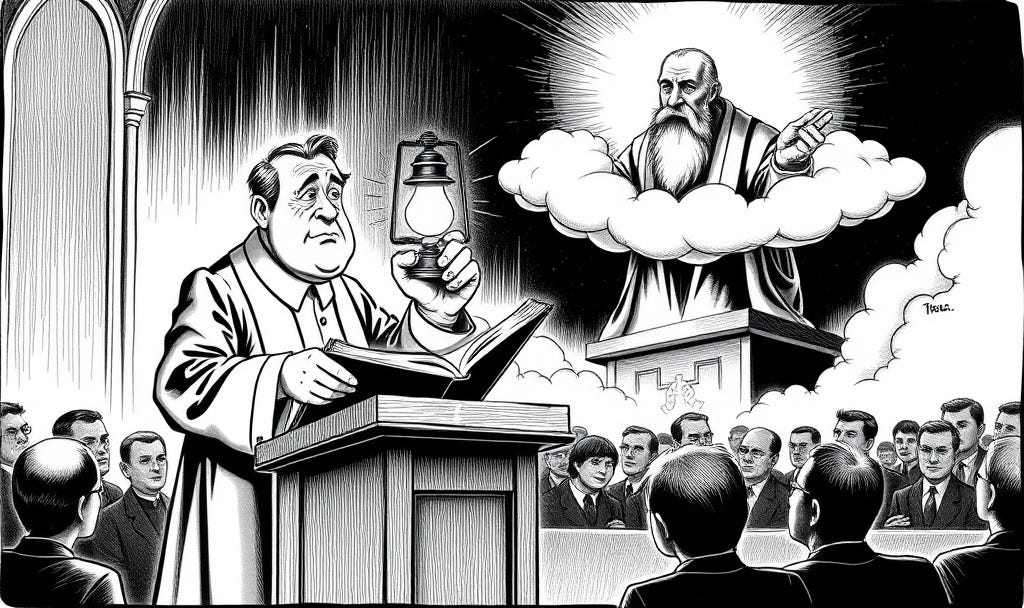
Hypocritical religion hides sin behind pious displays—fasting, prayer, and church attendance that fool people but never God. Isaiah exposed it long ago; Jesus fulfilled the law by revealing truth on the cross, covering our shame with His blood, and calling us to live as genuine salt and light.
“No Gaslighting God” — discover how God’s law brings true glory, not cover-ups, and how Christ’s finished work frees us to walk in good works that actually shine.
Epiphany 5
Psalm 112:1-10; Isaiah 58:1-12; 1 Corinthians 2:1-16; Matthew 5:13-20
You can also subscribe to this podcast on Apple, Spotify, or YouTube.
I.
We are examining in today’s readings something which we call today “gaslighting.” Gaslighting is, in fact, quite old, going all the way back to the time of Isaiah.
Gaslighting is a form of psychological manipulation, causing one to doubt his own perceptions, memories, sanity, or understanding of reality.
Though he wouldn’t have used the term, Isaiah accuses Israel of attempting to gaslight God, of overwhelming God with their pompous religious displays — including fasting — so as to hide the fact they are wicked.
In Isaiah 58:2 God says, “they seek me daily, and delight to know my ways, as if they were a nation that did righteousness and did not forsake the ordinance of their God.”
God is not faulting His people for missing church on Sunday morning. No. They make a point of showing up to hide what they did Saturday night.
They make a point of showing up, on time, and of sitting in the front pew, right under the pulpit, so the minister won’t miss them.
However they may succeed in using the ordinances of religion and worship to gaslight the minister and their fellow parishioners, they can’t gaslight God.
God charges His prophet Isaiah to “Cry aloud, spare not, lift up your voice like a trumpet; declare to my people their transgression, to the house of Jacob their sins” (Isaiah 58:1).
You cannot cause God to doubt His own perceptions, memories, sanity, or understanding of reality. Any attempt to use prayer, worship, or God’s law to deceive God will have disastrous consequences.
Isaiah spells out three of those consequences in verse four.
The first is “to quarrel and to fight,” or, in the King James Version, “strife and debate.” This means to argue over religious matters without ever producing the fruits of the Spirit.
Jesus accuses the Pharisees of this and Paul describes them as “holding the form of religion but denying the power of it” (2 Timothy 3:5).
A friend of mine visited Israel last month and told me of a stop on their tour at a Talmudic school. (The Talmud is the collection of rabbinic commentary on the Torah.)
He told me that he observed in the school young boys mastering the rabbinic arguments, imitating their form of “strife and debate.”
He asked the teacher, “Do they ever come to a resolution? Do they ever decide what the law means?”
The teacher’s reply floored my friend. “Resolution is not the point. The point is to learn to think like the rabbis.”
This is exactly what Isaiah warned about. The point is not, in fact, to learn to think like men, but to learn to think like God, to learn to think God’s thoughts after Him.
Jesus saw the direction the Jewish religion was headed in — He shared Isaiah’s concern — and He tried to stop it. This is why He began His preaching ministry with a sermon on Isaiah (Luke 4:16-21).
The second consequence of attempting to gaslight God is to “to hit with wicked fist.” This is not referring to an honest fist fight over some legitimate grievance, but to religiously-motivated violence, to persecution.
Throughout history the Church has been hit with a wicked fist when her enemies persecute her. Isaiah is no doubt alluding to the violence done in Israel to the prophets.
Jesus describes this in Matthew 23:29-30, “Woe to you, scribes and Pharisees, hypocrites! for you build the tombs of the prophets and adorn the monuments of the righteous, saying, ‘If we had lived in the days of our fathers, we would not have taken part with them in shedding the blood of the prophets.’”
The third is the worst and most dire consequence of all: gaslighters are forsaken by God.
God says, “Fasting like yours this day will not make your voice to be heard on high.”
II.
Given the abuse of God’s law and the hypocritical use of religion, you might expect Jesus to come and abolish the law and the old religion.
Many Christians down through the centuries believe that’s just what He did. But Jesus says in today’s Gospel: “Think not that I have come to abolish the law and the prophets; I have come not to abolish them but to fulfil them” (Matthew 5:17).
What today’s reading from Isaiah and this morning’s reading from Matthew are talking about is the true purpose of God’s law — as expounded by the prophets.
What both these passages say is that the point of the law is not to cover things up, but to bring things to light.
Later in Matthew’s gospel, Jesus says, “nothing is covered that will not be revealed, or hidden that will not be known” (Matthew 10:26).
Jesus is the Word of God incarnate, the living Torah, the living law, and, because He is these things, He reveals the law’s true purpose.
In this morning’s Gospel, we pick up in the middle of the Sermon on the Mount. Jesus is instructing His disciples, while a crowd looks on.
He tells His disciples not to lose their salt and to be light in a dark world. “You are the salt of the earth… You are the light of the world,” He says.
Because of them, their saltiness and their light, men will give glory to God.
Jesus says, “Let your light so shine before men, that they may see your good works and give glory to your Father who is in heaven” (Matthew 5:16).
Jesus is establishing His disciples as a lawful, biblical authority over and against the Pharisees.
The implication is that the Pharisees have lost their salt and their light.
He calls them “blind guides” in Matthew 15:14 who have lost their ability to teach: “if a blind man leads a blind man, both will fall into a pit.”
This is one of the consequences of gaslighting. Eventually, even the gaslighters themselves are deceived by their own lies.
When Adam and Eve broke the first law, they knew shame. Their response was to hide and to cover their nakedness — something Isaiah alludes to in Isaiah 58:7.
But God asks: is not a true fast, a fast pleasing to Me, “when you see the naked, to cover him”?
Fast-forward several thousand years from the time of Adam and Eve and the Pharisees are still “covering up” — and using the law to do it.
Jesus, speaking to His first disciples, who would become apostles, warns them not to do this.
Law that covers up crime, or excuses wickedness, or engages in legal discourse only for the sake of debate, not resolution has lost its salt. It sheds no light.
If that is what the abuse of God’s law accomplishes, imagine what fulfillment will bring? Jesus tells us in Matthew 5:19, “he who does [these commandments] and teaches them shall be called great in the kingdom of heaven.”
This is an improvement not only of our present circumstances but also of our original condition in the Garden of Eden.
In Paradise, God called us good. In the kingdom we shall be called great.
So we must: We do the works of the law and teach others to do them — not to gaslight and take advantage of them, or to manipulate God into letting us go to heaven — but to give glory to God who created these good works for us to do in the first place.
III.
But instead, we would rather prepare works of our own to walk in.
I look at the world we live in today and two words come to mind: failure and exhaustion. Failure because we cannot undo the effects of sin. Exhaustion because we are worn out from trying.
I am sometimes asked the question, “How much longer can this go on?”
The answer is: for quite a bit longer. After all, it’s been going on for all of human history. Yet the end, like Hemingway going bankrupt, comes gradually, then all at once.
I believe we are a nation, a people, a race, under God’s judgment. As St. Paul puts it in today’s reading from 1 Corinthians 2:6, we are “the rulers of this age, who are doomed to pass away.”
Paul continues in 1 Corinthians 2:14, “The unspiritual man does not receive the gifts of the Spirit of God, for they are folly to him, and he is not able to understand them because they are spiritually discerned.”
One of those gifts of the Spirit of God is the law of God, which includes the correct definition of religion, and the right rubrics of worship.
But many a religious man uses the law of religion to continue Adam’s cover up, to make dressings of fig leaves for himself and his wife, to cover their shame and nakedness.
The religious man, like his father, Adam, sees the law as a tool to get what he wants. He does not see it as a good work created by God long ago for him to accomplish.
Do you see how thinking of “good works” as fellow creatures — that is, as creations of God just as you and me — resolves the whole debate of salvation by works versus salvation by faith?
We have faith that God has created good things for us to do, and then we find we have the power to do them.
The law is not meant to fix something that can’t be fixed. The legal concept of “making whole” — of restitution — seldom achieves its purpose entirely.
Does a malpractice settlement replace a living father or husband? Of course not.
At its best, law approximates justice, but at its worst, law is used to persecute the innocent and to hide the crimes of those in charge.
This is what Isaiah means in 58:3 when God says, “Behold, in the day of your fast you seek your own pleasure, and oppress all your workers.”
Fasting is a legal, religious act ordered by God, but Israel only turned to fasting as Adam and Eve turned to fig leaves — to cover their shame.
Genesis 3:21 tells us that “the Lord God made for Adam and for his wife garments of skins, and clothed them.”
The Bible doesn’t spell it out for us, but an animal had to die so that those garments of skins could become clothing to cover man’s shame and nakedness.
A sacrifice was required to accomplish what the law could only point to.
IV.
I said before that the most severe consequence of Israel’s attempt to use law and religion to gaslight God was that it caused God to forsake them, to stop listening to them: “Fasting like yours this day will not make your voice to be heard on high.”
There is a version of Christianity — a popular version — that takes a verse like that to mean that fasting and other religious acts have no place in the Church.
But Jesus says in today’s gospel, “Think not that I have come to abolish the law and the prophets; I have come not to abolish them but to fulfil them” (Matthew 5:17).
But to the chief priest, the scribes, and the Pharisees — all the elites and leaders of the Jewish religion — the law’s fulfillment sounded like a threat.
So they used a trumped-up charge of blasphemy — a legal fiction — to put Jesus to death.
There, on the cross, Jesus was hit with as wicked a fist as there is: death by Roman crucifixion.
And there, on the cross, He experienced the worst and most damning consequence of trying to gaslight God: divine rejection. “My God, my God, why have you forsaken me?” He cried (Matthew 27:46).
By fulfilling the law literally — by becoming a legal substitute, an unblemished lamb in the place of sinful man — Jesus exposed their hypocrisy.
He uncovered what they tried to hide. He showed the deadly consequences of persecuting the truth: the shedding of innocent blood and rejection by God.
But that means that the fulfillment of the law is now a completed work of God.
Nothing is lacking in His sacrifice, nor is it blemished by hypocrisy and the shameful attempts to cover up sin.
Instead, we who are saved, are covered by the blood of Christ.
Salvation is a story that begins with the animal who gave his life so that Adam and Eve could cover their nakedness, and ends with the Son of God who gave His life a ransom for many.
V.
It remains only for us to walk in this completed work of Christ.
Do you see how Jesus fulfills the law so that its demands are met? Paul says that “There is therefore now no condemnation for those who are in Christ Jesus” (Romans 8:1).
Or are you still trying to bend and twist the law into an elaborate cover up?
I said before that repeated efforts to cover up sin leave us exhausted, but the power in today’s lessons is that God’s law is not to cover things up, but to bring them to light.
In other words, I no longer need to abuse the law to hide my shame if I understand that Christ has me covered.
He’s not going to cover me. He’s not thinking about it. He hasn’t given me a pair of pants and left me without a shirt. He has covered me.
That sting I feel, that pang of consciousness, that lingering guilt is the law doing its job to bring my sins to light so I can repent of them. It is the Spirit searching me.
But I repent not as an act of self-atonement or self-salvation. I repent so that I can do the good works God has created for me to do.
Paul writes in Ephesians 2:10, “For we are his workmanship, created in Christ Jesus for good works, which God prepared beforehand, that we should walk in them.”
It turns out that the good works look a lot like the dead works I used to do when I was trying to save myself and hide my shame.
It looks like putting an end to wickedness, breaking the yoke of the oppressed, sharing my bread with the hungry, and clothing the naked.
Only now, instead of applying a passage like that from Isaiah to guilt people into adopting socialism and big-government solutions, I see it how God intended it: as a covenant, a legally-binding agreement, that Christ fulfilled and set me free to keep.
This is the best encouragement I can give you. When you’re struggling with a sin, or finding it difficult to complete a good work, remember, the work is already finished.
God created it, it will be accomplished. Your task is to bear the fruit of Christ’s completed work.
This is the grace of obedience rather than the sin of striving, which leads to exhaustion.
If you remember that, then you will become what James and Paul call doers of the law and not hearers only (James 1:22; compare to Romans 2:13).
To all doers of the law God says, “you shall call, and the Lord will answer; you shall cry, and he will say, Here I am.”
Then, God says, “your ancient ruins shall be rebuilt; you shall raise up the foundations of many generations; you shall be called the repairer of the breach, the restorer of streets to dwell in.”
That is a vision of a Christian nation, of a godly people living as God intended: as salt, as light, as a city on a hill, and who give glory to God.
Preached on February 7, 2026, at the First Congregational Church, Woodbury, Connecticut (https://www.firstchurchwoodbury.org).


