

Lent 5
Psalm 130; Ezekiel 37:1-14; Romans 8:6-11; John 11:1-45
You can also subscribe to this podcast on Apple, Spotify, or YouTube.
I.
I am putting before you this verse from our readings this morning, Romans 8:7, that reads, “For the mind that is set on the flesh is hostile to God; it does not submit to God’s law, indeed it cannot.” I put it before you for two reasons.
The first reason is that it is the key to understanding our two other readings this morning — two great illustrations of one mighty doctrine — that man cannot save himself, that he is utterly incapable of cooperating with God in his salvation.
The second reason I put this verse before you is that this doctrine — more than any other doctrine, or teaching, of the Christian faith — is the living, beating heart of the gospel of Jesus Christ: man cannot save himself.
Therefore if he is to be saved at all, man needs a savior.
II.
That savior is Jesus Christ.
For the third week in a row, we have a lengthy reading from the Gospel of John.
For the third week in a row we hear words so clear, so direct, that their meaning cannot be misunderstood.
First, we heard from the Samarian woman at the well.
Last week, we heard it from the man born blind.
And this week, we hear it from Martha: “Yes, Lord; I believe that you are the Christ.”
Scripture is not always so plain as this. Here it is very plain. Jesus is the Messiah. Jesus is the Son of God. Jesus is the Christ and Christ alone can save us.
John uses the story of Jesus raising Lazarus from the dead to illustrate this point.
Catalyst. Lazarus falls ill and his sisters, Martha and Mary, send for Jesus.
When Jesus hears that Lazarus is ill, His response is similar to the answer He gave His disciples last week when they asked “Rabbi, who sinned, this man or his parents, that he was born blind?” (John 9:2).
This week, Jesus says, “This illness is not unto death; it is for the glory of God, so that the Son of God may be glorified by means of it.”
Once again we have to ask: “What does Jesus mean? Is he saying that blindness and illness — both of which are sources of immense human suffering — glorify God?
Are we to believe that God is glorified in the suffering of His creatures?
Last week, I said that it seems that the answer is yes. The man was born blind so that Jesus could heal him. Lazarus gets sick and dies so that Jesus can raise him from the dead.
Why? The answer comes at the end of our reading, at John 11:45, “Many of the Jews therefore, who had come with Mary and had seen what he did, believed in him.”
Lazarus had to get sick and die, so that Jesus could raise him from the dead — and this became the means by which many Jews came to faith.
The disciples did not want Jesus to return to Judea. They say, “Rabbi, the Jews were but now seeking to stone you, and are you going there again?”
There are two things I need to say before I give the meaning of this verse.
First, as I said last week, as needs to be said whenever we read John’s Gospel, “the Jews” almost always means the Jewish leaders, specifically in Judea.
Second, I need to clarify what I think is going on in verse 6, because I don’t want you to get distracted by that, and to miss the point of this whole passage.
When Jesus says in John 11:6, “So when he heard that he was ill, he stayed two days longer in the place where he was,” I don’t think we can take that to mean that Jesus purposely delayed going to Lazarus.
He certainly didn’t drop everything and go, but I don’t think He deliberately wasted two days either. The text simply means He did not go to Bethany for another two days.
It’s important to emphasize how dangerous it was for Jesus to return to Judea.
The disciples ask: “Rabbi, the Jews were but now seeking to stone you, and are you going there again?”
To which Jesus replies, “Are there not twelve hours in the day? If any one walks in the day, he does not stumble, because he sees the light of this world. But if any one walks in the night, he stumbles, because the light is not in him.”
This is a proverbial way of saying “Relax. Nothing is going to happen to me.”
The disciples are not convinced. This will not go well for them either.
It takes Thomas — doubting Thomas — to show some guts, to encourage the other disciples to go. He says: “Let us also go, that we may die with him.”
In other words, “Where Jesus goes, we go. If He dies, we die with Him.”
But Jesus’ point is simpler, more basic. Like the work of creation itself — seven days followed by rest — nothing keeps God from accomplishing His works, not even man’s disobedience to the divine will.
Jesus says: “This illness is not unto death; it is for the glory of God, so that the Son of God may be glorified by means of it.”
In verse 43 John writes, “When [Jesus] had said this, he cried with a loud voice, ‘Laz′arus, come out’” (John 11:43). Those words are spoken by the Son of God. They impose a duty on every man who hears them.
Lazarus has an obligation to rise up from his grave and come out of his tomb.
If these words are spoken to you, then you too have the same duty and obligation.
You must shake off death, as it were like, a night’s sleep and walk out of your tomb.
III.
But a dead man simply has no power to obey, to rise up, to shake off death, and to come out of his tomb.
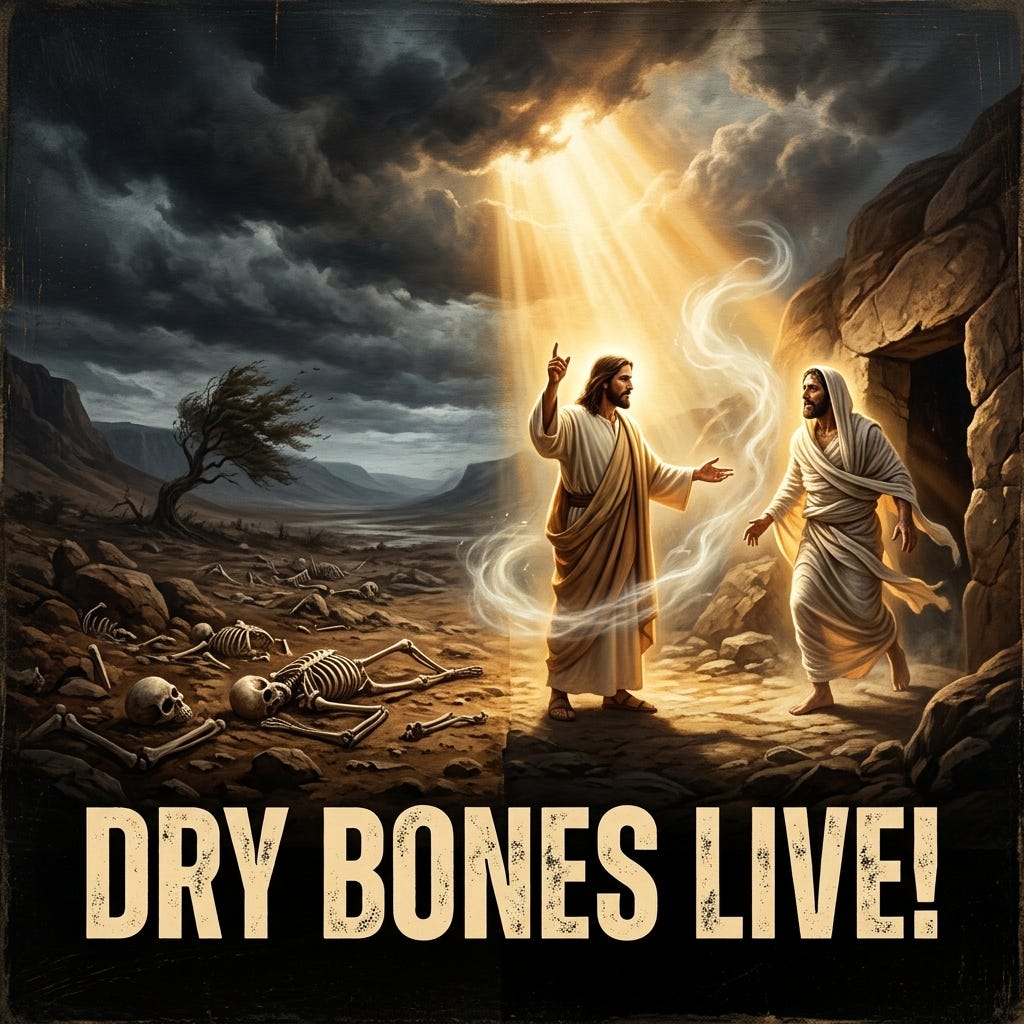
How, then, is Lazarus able to do it? Only by the power and working of God. In this morning’s reading from Ezekiel, God asks, “Son of man, can these bones live?”
To which Ezekiel replies, “O Lord God, thou knowest,” which is the polite way of saying no to God. In other words, “No, not unless you say the word, God.”
But if God commands these bones to live, then they must live. If Jesus says, “Laz′arus, come out” then Lazarus must come out.
Yet this is impossible. It is impossible for a valley of dry bones to reconstitute itself into the living army of Israel, and it is impossible for Lazarus to raise himself from the dead.
This is why both Israel and Lazarus need a savior. They are incapable of obeying God’s word without one.
Disobeying God’s word is always sinful. It is always a sin to disobey God.
If God calls you out of the grave and you refuse to come out, then you are confirmed in your sin.
Even if you managed to say, “God, I am a dead man, I cannot come out of the grave,” you still have no excuse.
God has spoken. Therefore, you have the duty to obey, even if you are incapacitated by sickness and death.
Here is the great difference between Protestant Christians and all other less-than-biblical forms of Christianity.
This is the principle difference between the Reformed believer and the Roman Catholic or the Eastern Orthodox.
Only the Protestant Reformed faith teaches this doctrine unequivocally, clearly, and without flinching: fallen man is utterly incapable of obeying God’s commandments.
He is a dead man and cannot obey Christ’s call to come out from his tomb.
He cannot cooperate with God. He cannot assent to God’s call. He cannot receive God’s grace.
In short, man cannot save himself. He needs a savior.
We — you and I — need a savior.
IV.
If man is to be obedient to God’s word, then the only way in which he can obey is for God — and only God — to will it, to command it, to do the work Himself.
God says to Ezekiel, “Prophesy to these bones, and say to them, O dry bones, hear the word of the Lord. Thus says the Lord God to these bones: Behold, I will cause breath to enter you, and you shall live… I will put my Spirit within you, and you shall live” (Ezekiel 37:4, 14).
Resurrected Israel in the valley of dry bones reveals God in all His glory.
Lazarus coming out of his tomb shows God in all His glory.
Christ on Easter morning is radiant in all of God’s glory.
Reformed Protestant theologians have a word for this doctrine. It’s called monergism. It means that man’s salvation is the word of God alone, for the glory of God alone.
It means dead men like Lazarus can only be raised by God working by Himself to save us.
Roman Catholics, non-Reformed Protestants, and Eastern Orthodox believe that man must cooperate in his salvation, that even in the tomb, Lazarus can still hear the call of Jesus and cooperate.
This is called synergism, which is the false doctrine that we cooperate with God in the work of our salvation.
This sets up every abuse in worship and corruption of doctrine you find in other types of less-than-biblical Christianity: from the sacrifice of the Mass — the notion that we unite ourselves to Christ’s work on the cross as He is represented on the altars of Roman churches — to the anabaptist idea that it is wrong to baptize infants.
We no more do the work of saving ourselves than a baby baptizes himself.
Lazarus was utterly incapable of obeying the call of Jesus to come out. Jesus had to obey for him, an act of obedience that led Him to the cross.
We cannot cooperate with Christ’s work on the cross. We cannot offer ourselves along with Him. Jesus suffered there alone.
This is why the Roman Catholic custom of offering a mass for a specific intention, or worse, of making a contribution of money to have a mass said for a dead person, is such an offense to Jesus.
Think about it. You are offering to pay Christ, to hire Him, to go to work for you on the cross for your — or your dead relative’s — salvation.
You don’t hire Christ. Jesus doesn’t work for you.
God forbid! The very idea is an abomination and destroys the whole gospel.
This was Martin Luther’s point. This is what ignited the Protestant Reformation.
When Christ calls you you must obey, but being dead in sin and trespass, you cannot obey.
However, once He gives the word, once He utters the command that even death cannot resist, then, and only then, can you rise and walk out of your own tomb.
Once you are saved, there is much work for you to do.
Once you are saved, cooperation with God is finally possible.
V.
Now, let me say two things in conclusion about this cooperation, this newfound freedom to cooperate with God, in the works He has prepared for us to do.
First our freedom in Christ resolves the apparent contradiction in this morning’s reading from Romans 8.
Paul writes in verse 6, “To set the mind on the flesh is death but to set the mind on the Spirit is life and peace.”
This appears to say that it is we who are the doing the setting, that we choose to do the works of the flesh when we could just as easily choose to set our minds on the Spirit and do the works of the Spirit.
But Paul is clear in verse 7, “the mind that is set on the flesh is hostile to God; it does not submit to God’s law, indeed it cannot.”
We have seen how the resurrection of Lazarus, when Jesus calls for him to come out of the tomb, illustrates Paul’s point.
Second, this freedom in Christ establishes the supremacy of the Protestant Reformed faith, because this faith alone is faithful and consistent with the biblical text.
So yes, this doctrine of monergism, of salvation being the work of God alone, argues for Protestant supremacy.
Only Reformed Protestants can rest confidently in the knowledge that they are saved, because they understand that Christ alone has finished the work that needed to be done.
Protestant confidence does not rest in man, or in themselves, or in access to the sacraments, or even membership in the church.
Protestant confidence rests in the glory of God — the God who works alone — the God who does not share His glory — but instead allows us to see it (Isaiah 42:8, John 11:40).
This is why Protestants had the confidence to come to New England nearly four centuries ago, to work with God — not to put God to work for them — building a people and nation that reflects God’s glory.
What a fitting end to Lent — as we look forward to Palm Sunday, Good Friday, and Easter — to hear Jesus say to Martha: “Did I not tell you that if you would believe you would see the glory of God?”
Preached on March 22, 2026, at the First Congregational Church, Woodbury, Connecticut (https://www.firstchurchwoodbury.org).


