

God’s Word is complete and sufficient: Eve added to it and fell; Christ quoted it faithfully and triumphed. The garden required guarding; the Church demands the same courage today—expel compromise or face judgment. Honor God’s “secret kindness” with gratitude and fearless obedience.
Lent 1
Psalm 32; Genesis 2:15-17, 3:1-7; Romans 5:12-19; Matthew 4:1-11
You can also subscribe to this podcast on Apple, Spotify, or YouTube.
I.
I want to continue to develop a point I made last week, that the word of God written is the basis for all reality.
The Bible, you will recall from my previous sermon, is defined as the record of the prophetic and apostolic word, what St. Peter called “the prophetic word made more sure” (2 Peter 1:19).
The whole point of Jesus’s transfiguration — that momentary revelation of His glory before Peter, James, John — was to make that word “more sure”; in fact, to mark that word as complete.
This is why the voice from the cloud was so adamant that we should “listen to him.”
The voice from the cloud said, “This is my beloved Son with whom I am well pleased; listen to him” (Matthew 17:5)
I pointed out that heresy — false teaching, false beliefs — begins to take root whenever we stop listening to Him and start listening to ourselves.
In less-than-biblical versions of Christianity, this becomes the source of continuing revelation — by making the Church an extension of the incarnation — thus elevating her words — the words of uninspired men — to the level and authority of the Bible.
The Muslims and Mormons have also added to the “the prophetic word made more sure” by granting equal status with the Bible to the Koran and the Book of Mormon.
The Roman Catholic Church codified this error in the doctrine of papal infallibility.
In theory, however unlikely it may seem, nothing prevents the Pope from promulgating a new revelation, or even from certifying the Koran or the Book of Mormon as Holy Writ.
Roman Catholics will tell you that will never happen, but, within living memory, they have had to eat such words more than once.
I recite these points from last week’s message with you now because we have in this morning’s reading from Genesis, the example of the woman, later named Eve — everywhere and for all time the mother of heretics, schismatics, and false teachers — doing just that.
Instead of listening to Him, she listens to herself.
Very well, then. Let us turn now and examine the temptation and corruption of our first parents.
II.
Both our Old Testament and Gospel lessons this morning feature temptation, the temptation of the woman and the temptation of Jesus.
Adam is planted in the garden of Eden to till and keep it. God gives Adam a commandment: “You may freely eat of every tree of the garden; but of the tree of the knowledge of good and evil you shall not eat, for in the day that you eat of it you shall die.”
This is the word of God. Adam is to listen to Him.
This is also the complete word of God: “You may freely eat of every tree of the garden; but of the tree of the knowledge of good and evil you shall not eat, for in the day that you eat of it you shall die.”
Nothing more can be added to it, nothing taken away.
Now, you may say, “Hang on. This is only the second chapter of the first book in the Bible. There are forty-nine more chapters to go, sixty-five books left to read. Surely, God has more to say.”
Here we come up against one of the first great mysteries of our Christian faith: God’s word is one word. Like God Himself, it lacks nothing. It is by nature complete and whole.
But you say, “There are many other words than just this one. Many more commandments to obey. ‘Do not eat of the tree’ was only the first.”
And so here we come to another mystery of our faith: God is one and God is three. The word of God is always complete, it is always the last word, it is always the final thing God has to say about Himself, yet it is recorded over many hundreds of years, in testaments both old and new.
How are we to make sense of this? How are we to square this circle?
Well, we can’t. The mysteries of our religion defy the categories of the human mind.
These mysteries are not resolved in abstractions, like they are in Islam, or endlessly contested, as they are in Judaism.
No — in Christ they are resolved personally: ‘Listen to him.’ That is the final word.
The complete word of God, in every dispensation, is the means by which we resist temptations to sin, the flesh, and the devil.
In Genesis 3, the woman is confronted with this challenge from the serpent: “Did God say, ‘You shall not eat of any tree of the garden’?”
Let’s look at the woman’s response. She begins by quoting the word of God. She begins with the positive command: “We may eat of the fruit of the trees of the garden.”
Now, we skipped verses 18-25 in Genesis 2 which covered the creation of the woman. One thing those verses do not tell us is how the woman came to know the word of God.
She had not yet been created when Adam received the commandment. The verses about her creation do not record a separate or private revelation given to her.
There is no Gospel According to Eve of some secret knowledge meant only for the woman or for women in general.
Yet by chapter 3, she can recite the word of God. She has been catechized. She has been discipled — presumably by her husband — though the subtle presence of the serpent in the garden does not rule that he has been secretly instructing her as well.
The Hebrew noun used here is translated as snake or serpent, but the verb form of the same word means “to practice divination,” “to observe omens,” “to enchant,” or essentially “to engage in sorcery/witchcraft.”
Thus, the Bible gives us a clear warning, very early on, about the way in which female spirituality can go wrong.
This is one reason why the Church, up until very recently, refused to grant women any kind of preaching or teaching authority. This was to guard against the very pattern set in Eden.
There are exceptions, both in the Old and New Testaments, but only when it comes to words of prophecy, never for the office of overseer or elder, roles that are considered “apostolic.”
The operations of divination, of enchantment, of sorcery and witchcraft are conducted by words — the adding of words — the heaping up of words into spells and incantations.
This is exactly what the woman has done. She has added to the word of God.
God’s complete word in Genesis 2:16 is: “You may freely eat of every tree of the garden; but of the tree of the knowledge of good and evil you shall not eat, for in the day that you eat of it you shall die,” but the woman adds, “neither shall you touch it.”
Five small words that sound like good advice. Perhaps they even came from Adam’s instruction: “Woman, do not eat of this tree, in fact, don’t even touch it.”
Regardless of who added these words, it showed a lack of faith. God’s word was not sufficient. It was lacking, incomplete.
It needed rationalizing, it needed an addendum, a second canon, an apocrypha — something — anything — that can be used to make a point other than the point God wants to make: “for in the day that you eat of it you shall die.”
Having already doubted the sufficiency of God’s word, it was not too hard for the serpent to get the woman to doubt its plain meaning as well: “the serpent said to the woman, ‘You will not die.’”
Not too many years later the woman will watch helplessly as her son, Abel, bleeds to death in the field, slain by her other son, Cain.
And here we are all these many years later, a race of dying men, children of Eve, born to die.
If God wants one thing from us — if there is one overall theme in the Bible — it is that God asks us to put our faith in Him, not in an institution, not in an abstraction, but in Him.
Adam and Eve failed the test of faith before they ever took a bite of the fruit. They doubted God’s complete and final word.
That doubt led to lust of the eyes — “when the woman saw that the tree was good for food, and that it was a delight to the eyes” — and then to disobedience of the flesh: “she took of its fruit and ate; and she also gave some to her husband, and he ate.”
Yet God gave us a sufficient word. Both then, in the garden, and now, in the present day, we have His complete word.
We must use that word to defend the very creation which God established upon it.
III.
It is very difficult to pin down the exact moment when the woman sinned. The first bite certainly consummated her disobedience, but, as Jesus tells in the Sermon on the Mount, even to look at a woman with lust is the same as to lie with her in bed (Matthew 5:28).
For this reason many commentators date Eve’s sin to Genesis 3:6, “So when the woman saw that the tree was good for food, and that it was a delight to the eyes...,” but Calvin says that “the impure look of Eve” already bore witness to “an impure heart.”
She had already lost her faith in the sufficiency of God’s word alone. By the time she confronted the serpent she — or someone — had committed the adultery of mixing God’s word with the words of men.
This moves the commission of the original sin to some point prior to her eating the forbidden fruit, or even looking at it.
Doubt came first, but not doubt as we think of it, as uncertainty, uncertainty about a prediction, an outcome, or the truth of something.
Hers was an apostasy — an apostasy in which Adam joined her. It was the conscious abandonment and renunciation of their faith, a faith they both knew to be true.
Genesis 3:6 says: “The tree was to be desired to make one wise.”
The man and the woman attempted to become like God, first by adding to His word, then — at the suggestion of the serpent — by seeking to own the knowledge of good and evil: to decide for themselves what such things mean.
They had been made in the likeness of God, now they demanded equality.
Genesis 3:7 says: “Then the eyes of both were opened, and they knew that they were naked; and they sewed fig leaves together and made themselves aprons.”
Having lost the covering of faith, they covered themselves in their own works, aprons of sown fig leaves, a work wholly insufficient for life outside the garden, for a world without God.
IV.
Fortunately, God’s word did not fail our first parents, even when they were at their worst. We turn now to see how Christ availed Himself of that word, when He faced His own temptation.
In Matthew 4:4, Jesus is tempted by Satan to prove He is the Son of God by turning stones into bread. Jesus quotes Moses in reply, from Deuteronomy 8:3, “Man shall not live by bread alone, but by every word that proceeds from the mouth of God.”
Like the first woman, Jesus quotes the word of God. Unlike the first woman, He says these words in good and perfect faith.
He does not need to add to them. He knows they are sufficient.
He knows they are sufficient because He is God, and He knows His own word is sufficient, for all times and places, to make a covering for sin.
This covering is not like the hastily constructed and scanty aprons of fig leaves Adam and Eve wore, but a rich robe, a robe of righteousness that all who put their faith in Him can wear.
There is more to this faith than first meets the eye. The “woman saw that the tree was good for food.” What she did not see — and could not see — was the power that made it good.
That power is secret. Calvin calls it the “secret kindness” of God that makes things what they are: bread good for food, Scripture to make one wise in the knowledge of God.
This is why we can truly say that the Bible is the basis for all reality — and not by any magic or superstition.
You will see Roman Catholics kiss the Bible and cast incense at it. You will see Jews reverently touch the Torah scrolls. But those are merely external honors, gestures of respect, for this secret kindness.
It is the power of God that makes the Bible what it is: the true bread by which we live. “Man shall not live by bread alone” — not by the outward sign alone — “but by every word that proceeds from the mouth of God” — by the secret kindness that makes those words true.
There is no need to resort to witchcraft and sorcery — to the serpentine religion that deceived Eve — when we have access to the secret kindness of God holding everything together.
We give true honor to this secret kindness by faith, not by external religious ritual.
V.
I would like to end with a demonstration of two ways Christians can honor the secret kindness of God.
The first is gratitude. St. Paul writes today about the “free gift” that is Jesus Christ to the whole world. If Adam and Eve bequeathed their children the curse of death, Christ’s “act of righteousness leads to acquittal and life for all men.”
You may object that not everyone has the opportunity to hear of Christ, or that many thousands of years had passed before Christ came to make this “act of righteousness,” so this free gift can’t have been given to all men.
I must underscore the point I’ve been making from the beginning: the word of God is always complete, always the last word, always the final thing God has to say about Himself, so no generation, before or after Christ, has ever been deprived of its saving power.
The word of God was sufficient in the garden for Adam and Eve. It was sufficient in the wilderness for Jesus.
Christ’s act of righteousness only made the prophetic word more sure. He added nothing to that word.
Very well. So much for those who came before Christ. What about those who’ve lived since then, or who live today, and have not heard the message of the Gospel?
They too have no excuse. Why? Because the word of God is one, it is complete, it is sufficient.
They may not have that word made more sure — the way I am making it now — the way preachers have labored to do in every age — but they are not without the word of God in all its fullness.
John 1:1-2 tells us “In the beginning was the Word, and the Word was with God, and the Word was God. He was in the beginning with God; all things were made through him, and without him was not anything made that was made.”
This is why Paul can write in Romans 1:20, “Ever since the creation of the world his invisible nature, namely, his eternal power and deity, has been clearly perceived in the things that have been made. So they are without excuse.”
Every man, woman, and child who was ever conceived in the womb is a full, perfect, and sufficient testament to the complete word of God. Every man now living owes a debt of gratitude to God for this secret kindness of God.
Very well, that is the first way, gratitude. The second is courage. This is something woefully lacking in today’s Church. It was lacking in the garden as well. Adam and Eve showed a lack of courage in the face of apostasy.
They tolerated a false brother, secretly brought in, to spy out their freedom and ruin them. Rather than cast it out, they sought their own gain.
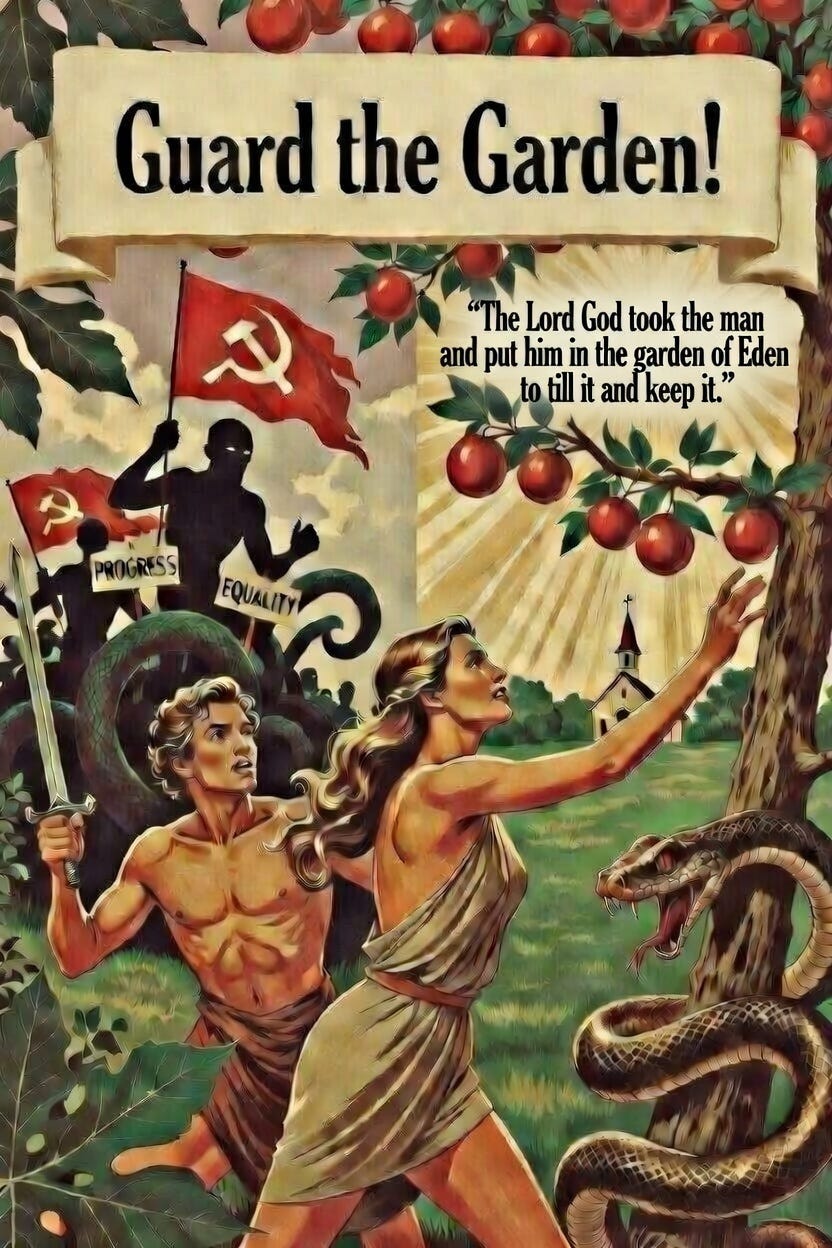
Genesis 2:15 tells us the man was placed in the garden to “to till it and keep it.” Keep here doesn’t just mean to keep it tidy, but to guard it. You see that in the older English use of the word keep as noun. As a noun, keep means a castle or fortress.
The garden of Eden was a type of the Church that was to come, just as Paul says in today’s reading that Adam “was a type of the one who was to come” (Romans 5:14). Paul is referring, of course, to Jesus.
Jesus makes it very clear that He expects us to keep His Church, to guard it and protect it.
You may say of course we should guard and protect the Church, but I ask in reply, do you have the courage to do it?
Do you have the courage to set rigorous standards of membership? Do you have the courage to say no to those who do not meet those standards? Do you have the courage to discipline those who are already members when they falter?
If the answer is no, or — as will more likely be the case in practice — you find that, like Eve, that you’re adding words — adding them in order to hide the plain meaning of membership, then you show a lack of courage.
What Adam and Eve should have done is bind the serpent and cast it out of the garden. Then and there, in the wilderness, Adam ought to have driven a stake through its head.
So far, this is hypothetical. Standards of membership exist on paper. Talking serpents are the stuff of myth. Very well, let’s make it concrete.
Should we admit members of the Nazi Party to church membership? Admittedly, that’s still something of a hypothetical. The Nazi Party hasn’t existed for 80 years.
What about the Communist Party USA? That very much exists. Can party members be church members? How about the Democratic Socialists of America? How about your next-door-neighbor, “In-This-House-We-Believe” Democrats?
You see, you pause now, because it would take some courage to actually say that, more to actually do it.
I tweeted last week that I wouldn’t recommend Democrats for church membership.
At last count the post had over 76,000 views, 682 comments, 224 retweets, and 1,500 likes. For a small account like mine, this is “going viral.”
I was being deliberately provocative to make a point. Based on the responses I got, the point was made: very few people understand what it takes to till and keep the Church.
It takes courage, of the kind only our Christian faith can inspire.
I have said that both the Church and this vineyard, this transplanted vine called Connecticut, are under God’s judgment.
It is a judgment we deserve. It is a judgment the Puritan fathers foretold would befall Connecticut if she ever abandoned her covenant with God.
The 1818 State Constitution disestablished this and other churches like it. The 1965 Constitution removed the Christian Religion from its privileged place in Connecticut law.
But these constitutional changes were trailing indicators. Connecticut had turned its back on God long before.
What is needed is for men, Christian men, to cast out the serpents in our midst.
Rupert Lowe, a member of the British Parliament, recently launched a campaign to restore Britain. In the launch video he said:
“There are no easy fixes. I’m not going to tell you comforting lies about the condition of our country. I have only ever been honest with the British people and I will be straight with you now. What is necessary will be incredibly painful.”
I do not know if Mr. Lowe is a born-again believer, but he displays courage. If feelings of national pride engender such courage, how much more ought the faith of Christians produce the courage necessary to rise and reclaim the Church?
What is necessary to restore the Christian Church will be incredibly painful. Many pastors, preachers, priests, and bishops — as well as members — will have to be removed.
Many stand in endowed pulpits, counting the years until retirement. To you say, it’s time to go. Make way for God to act. Make way or God will act in spite of you.
The only reason this is going to be painful for us is because of sin, because our first parents refused to do it. They refused to cast down that ancient serpent. It is painful because Christ had to die a bloody death, painful, because you and I still “groan inwardly as we wait for adoption as sons, the redemption of our bodies” (Romans 8:23).
But it is necessary. When we let historic churches on Connecticut greens close — after letting them linger for decades in apathy or outright apostasy — when we allow them to be sold to become galleries, community spaces, “affordable” housing, or worse, mosques, we tell God we don’t have the courage, that we don’t have what it takes to till and keep the garden.
We commit Adam’s sin anew.
So we must summon that courage and remember His word, this perfect and sufficient word of God that caused the devil to flee: “You shall worship the Lord your God and him only shall you serve” (Matthew 4:10).
Preached on February 22, 2026, at the First Congregational Church, Woodbury, Connecticut (https://www.firstchurchwoodbury.org).


