


Lent 2
Psalm 121; Genesis 12:1-4a; Romans 4:1-5, 13-17; John 3:1-17
You can also subscribe to this podcast on Apple, Spotify, or YouTube.
I.
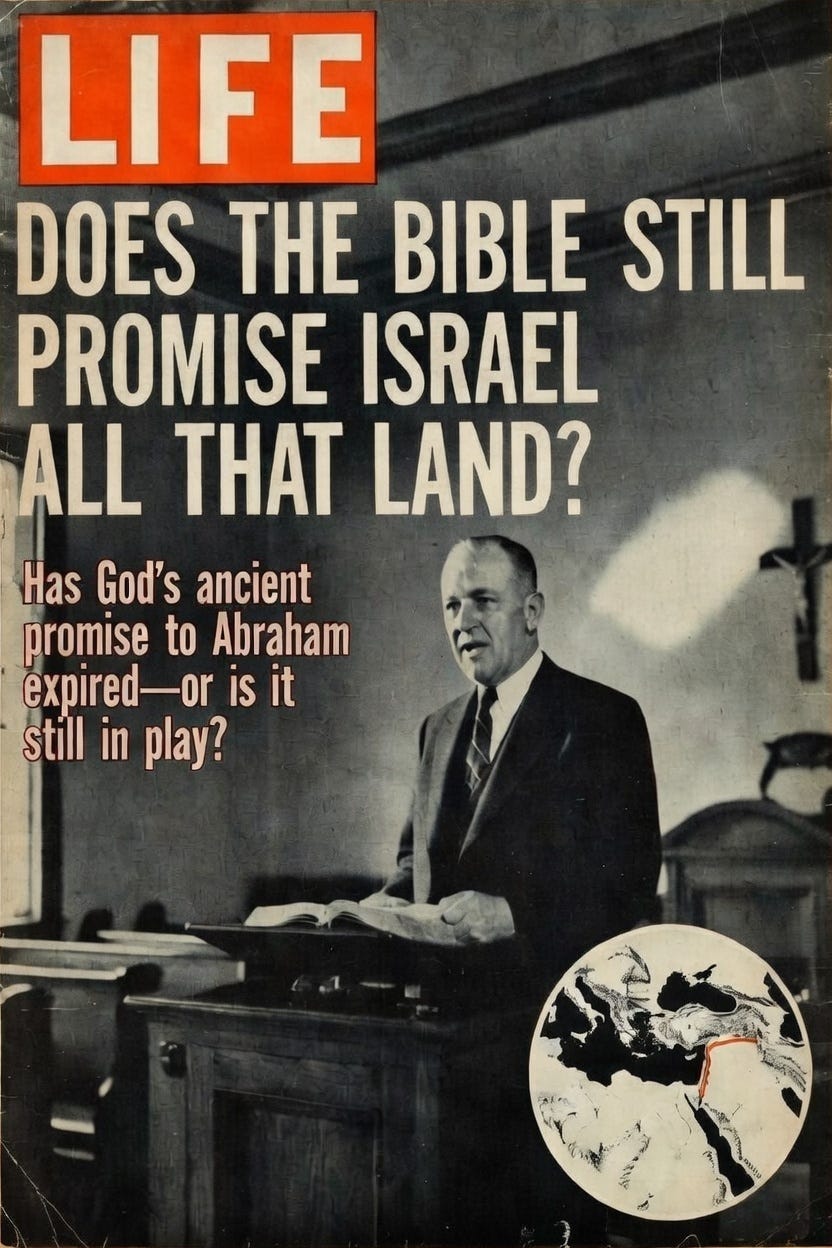
This morning we are dealing with several verses in Genesis that have become quite controversial recently.
The verses we are looking at contain two promises: the land promise and blessing promise attached to Abraham.
The first is the land promise of Genesis 12:1. “Go from your country and your kindred and your father’s house to the land that I will show you.”
The land is defined as Canaan in Genesis 12:5, a verse we did not read this morning.
The land is later expanded in Genesis 15:18 to include all the land “from the river of Egypt to the great river, the river Euphra′tes.”
On today’s map, this more expansive promise, if ever fully realized, would encompass:
All of modern Israel;
The Palestinian territories;
All or most of Jordan;
Parts of southern Lebanon;
Parts of southwestern Syria;
Parts of northeastern Egypt; and,
Small portions of northwestern Iraq.
The second promise is the blessing promise of Genesis 12:3. God says to Abram: “I will bless those who bless you, and him who curses you I will curse.”
Like the land promise, this promise is also extended. At first, it is spoken only of Abraham, later of all Israel.
The pagan prophet Balaam was compelled to bless Israel, despite being paid by a hostile king to curse Israel.
Balaam prophesies: “How fair are your tents, O Jacob, your encampments, O Israel!... Blessed be every one who blesses you, and cursed be every one who curses you” (Numbers 24:5, 9).
This extends the promise from the man Abraham to the nation Israel.
Now let us turn to the controversy. There are several surrounding Israel at the moment, but I will deal only with the first in today’s text: the land promise. Has the land promise been fulfilled?
The Bible tells us that it was fulfilled.
Joshua 21:45 says, “Not one of all the good promises which the Lord had made to the house of Israel had failed; all came to pass.”
Yet, despite that assertion, the Bible does not record the land promise coming true literally, at least not to the greatest extent possible.
Even during Israel’s golden age, under King Solomon, she never held territory as far east as modern-day Iraq.
Does this promise still hold?
U.S. Ambassador to Israel, Mike Huckabee, recently said that it did.
If it does, to what extent might the modern state of Israel fulfill it? The Ambassador drew criticism for suggesting Israel might fulfill it up to these biblical limits.
This is not a small controversy, and it is more than can be reasonably dealt with in one sermon, but I shall try to resolve it for you clearly, in light of today’s readings from Romans 4 and John 3.
II.
Let us first look at the story of Nicodemus in John’s Gospel.
Nicodemus is a Pharisee, the Jewish religious party that Jesus most sharply opposed and that most fiercely opposed Him.
Jesus takes this opportunity to remind Nicodemus that Judaism is a religion of grace, not works.
The meeting is controversial, or, at least, it would be if it was found out. For this reason Nicodemus comes to Jesus by night.
His words are sincere. This is not the flattery the Pharisees use in the other gospels to entrap Jesus.
Nicodemus means it when he says: “Rabbi, we know that you are a teacher come from God; for no one can do these signs that you do, unless God is with him.”
Jesus then teaches Nicodemus about the need to be born again — something Nicodemus balks at — asking, “How can a man be born when he is old? Can he enter a second time into his mother’s womb and be born?”
It is not a physical rebirth that Jesus speaks of but a spiritual and moral recreation — the cause of which cannot be explained in human terms.
Therefore, Jesus offers this analogy, “The wind blows where it wills, and you hear the sound of it, but you do not know whence it comes or whither it goes; so it is with every one who is born of the Spirit.”
In other words, you can feel it, you can see its effects, but you cannot explain why some are born again while others are not.
Not satisfied with that answer Nicodemus asks, “How can this be?”
Jesus’ answer is telling. It is telling about the miserable spiritual condition to which Israel’s religious teachers had fallen by Christ’s time.
Jesus asks, “Are you a teacher of Israel, and yet you do not understand this?” In other words, “How do you not know this?”
Jesus then says these damning words that haunt us to this day, “You do not receive our testimony.”
This amounts to not receiving Jesus Himself — the very definition of what it means to be damned.
This seems to suggest that Israel is no longer special. By not receiving His testimony, the Jews would lose God’s protection. Blessing and cursing them would mean nothing. They become just like any other nation, tongue, or tribe.
Perhaps. Or perhaps some echo of their original calling can still be heard, some national significance remains.
Regardless, Jesus immediately presents Nicodemus with a remedy for himself, for every Jew, and indeed for all who believe.
Jesus continues, “And as Moses lifted up the serpent in the wilderness, so must the Son of man be lifted up, that whoever believes in him may have eternal life.”
The key words here are “whoever believes.” That is a call to faith.
When Jesus says “Are you a teacher of Israel, and yet you do not understand this?” He is reminding Nicodemus that the Jews are first and foremost to be a people of clean and pure hearts (Ezekiel 36:25-27) precisely because they are a people of faith — like their father Abraham was a man of faith.
This is what St. Paul means in Romans 4:16, “That is why it depends on faith, in order that the promise may rest on grace and be guaranteed to all his descendants—not only to the adherents of the law but also to those who share the faith of Abraham.”
Briefly then, let us review where we are.
First, God makes promises to Abraham of land and protection.
Second, Paul tells us that the blessing of these promises rests on having faith.
Third, Jesus explains to Nicodemus that faith comes by the grace of God. There is no explanation that will satisfy the human mind as to why God gives this grace to some and passes over others.
All that can be said is that it is analogous to the wind as well as to God’s promises to Abraham.
There is no reason given as to why Abraham deserved these promises.
We must conclude that they are not deserved at all.
The promises are entirely unmerited. They are the free gifts of God.
III.
I said before that Jesus’ damning words seem to resolve at least one of the controversies surrounding Israel. If the Jews are, in fact, rejected — if they are no longer God’s people — then all of the other controversies are resolved too.
Therefore, a lot depends on getting this right. So, let’s make sure we do.
If Jewish unbelief — Jesus’ threefold complaint “you do not receive our testimony,” “you do not believe,” and “how can you believe?” — results in their losing the promises of God, then in what did Abraham put his faith?
Likewise, if the land promise was never fully realized, why did Joshua say: “Not one of all the good promises which the Lord had made to the house of Israel had failed; all came to pass”?
To read the Nicodemus story as Jesus’ rejecting His own people — the Jews — is to break Scripture, to deny God’s word.
How could the word of God incarnate, Jesus Christ, break Himself? God forbid. It is utterly impossible.
Furthermore, what good is God’s promise to us in John 3:16 that “God so loved the world that he gave his only Son, that whoever believes in him should not perish but have eternal life”?
What good is that promise if, like the Jews, we can at first believe and have eternal life and then just as easily lose our faith, only to die and go to hell?
Our salvation has to be more certain than that, otherwise, it isn’t salvation.
It has to be at least as sure and as certain as God’s promise to give Israel the land — all the land — from Egypt to the Euphrates, otherwise there is nothing for us to boast about.
I preached last week that Adam and Eve got into trouble for adding to the word of God. How much more trouble do we cause for ourselves if now we try to take away from God’s word? Not one jot, not one tittle, not one inch of the promised land.
Now, that is a very dangerous thing to say. It was dangerous then. It is still dangerous now.
I got into trouble last week for saying that the Bible is a polemic against evolution — that it is fundamentally a document about creation.
Well, Israel is part of God’s creation, and in that creation, this land is given to them.
But here’s the thing: it’s undeserved. The land is a free gift, an undeserved gift.
Just as Abraham did not earn God‘s favor and friendship, neither can Israel, ancient or modern, earn the land.
It must be given to them.
God’s word cannot be broken.
IV.
Now we must face the greatest controversy of all: Jesus, the very word of God Himself, is broken on the cross. That means all the promises of God, including the land promise, need to be reconsidered.
Paul writes in this morning’s reading, “For the law brings wrath,” which is exactly what the conspiracy hatched by the Pharisees and chief priests accomplished.
Together with the Sanhedrin, a hasty trial was conducted, witnesses procured, and Jesus condemned. From noon to three o’clock on that Good Friday the curse of the law reigned.
Paul writes, “for it is written, ‘Cursed be every one who hangs on a tree’” (Galatians 3:13).
God said to Abram, “I will bless those who bless you, and him who curses you I will curse.”
Matthew 2:15 is clear that Jesus is Israel.
He quotes Hosea 11:1, “When Israel was a child, I loved him, and out of Egypt I called my son.”
The transfer of the promise is completed on the cross: from the man Abraham, to the nation Israel, to the Messiah, Jesus the Christ.
In short order after His death, God’s curses fell on those who cursed Him. The earth shook, the temple curtain was torn in two (Matthew 27:51), and a generation later, Roman armies laid siege to their holy city, just as Jesus said they would (Matthew 24:1-2).
Yet those who blessed Christ in their day rose from their graves. Matthew tells us, “the tombs also were opened, and many bodies of the saints who had fallen asleep were raised” (Matthew 27:52).
All those who bless the Israel of God are blessed to this day: “so must the Son of man be lifted up, that whoever believes in him may have eternal life.”
Praise God for what Israel did on the cross! Or, I should say, praise God for what Jesus — the true Israel — did on the cross! Amen. Paul tells us “For all the promises of God find their Yes in him. That is why we utter the Amen through him, to the glory of God.” (2 Corinthians 1:20).
V.
Let us return to the controversy surrounding the land promise I brought up earlier. I said I would try to resolve it for you clearly in light of today’s readings. Surely a fool’s errand!
Has the land promise been fulfilled? Scripture tells us it has been fulfilled, history tells it has not. Which is correct?
Clearly, God’s word is correct. “Heaven and earth will pass away, but my words will not pass away” (Matthew 24:35).
God’s word is ultimate. History does not have the last word. God does.
Paul writes that God “gives life to the dead and calls into existence the things that do not exist.” That includes a history that has yet to happen.
But that future history will not be bound by the past. It will be bound by God’s word.
So, the promise stands. Now, does the modern state of Israel fulfill this promise? How much does it matter?
I will lose some of you here.
Some of you will expect me to say that it matters a great deal — that we are living in the fulfillment of end-times prophecy.
Others will expect me to say it matters very little, if at all — and that I should join the growing chorus of denunciation against modern Israel.
But I believe Scripture calls us to avoid making too much or too little of any of God’s promises.
Despite Jesus’ words: “You do not receive our testimony” — words that haunt unbelievers to this day — words that reveal a hardening of the Jewish heart, and an active and willing refusal to believe — even that cannot rob modern Israel of its God-given significance and today’s Jews of their special status.
The Jews matter because God says they matter. The land matters because God said it matters. It has pleased God to leave both as signs to mark His way.
Yes, the ultimate fulfillment is in Christ the true Israel (Matthew 2:15, Hosea 11:1), but God in His providence continues to allow ethnic Israel to remain with us to this day as a witness to His irrevocable gifts.
Paul himself says in Romans 11:29, “For the gifts and the call of God are irrevocable.”
Christians must tread carefully here.
Today’s Jews and modern-day Israel remain with us as signs. Even if they are old signs, they are signs that still point to the truth.
The “Benjamin Franklin” milestone on Main Street North here in Woodbury dates from the 18th Century, and it still reads clearly “XIV Miles,” though fourteen miles to where, exactly, is lost to history.
The Jews are not lost to history. Indeed, their survival and conversion are promised to take place in history.
The Jews are God’s original covenant people. They are the original Christians — the original messianic nation (Christ means Messiah or Anointed One). They are the original signpost pointing to Christ — even if they do not believe Christ came and that the covenant is fulfilled.
If you cannot see that the Cross of Christ fully, perfectly, and sufficiently satisfied the covenant’s terms, then these words of Jesus will continue to haunt you: “unless your righteousness exceeds that of the scribes and Pharisees, you will never enter the kingdom of heaven” (Matthew 5:20).
Preached on March 1, 2026, at the First Congregational Church, Woodbury, Connecticut (https://www.firstchurchwoodbury.org).
For Further Reading
In the writing of this sermon, I am deeply indebted to the following works, which helped shape my understanding of the covenant promises, Christ as the true Israel, the irrevocable gifts of God to His people, and the enduring significance of ethnic Israel as a sign of God’s faithfulness.
Hodge, Charles. Systematic Theology. Vol. 3. Grand Rapids, MI: Eerdmans, 1940, 805–811. Hodge’s careful discussion of the future of Israel and the consummation of God’s promises provided valuable insight into balancing God’s faithfulness to ethnic Israel with the ultimate fulfillment of all things in Christ.
Holwerda, David E. Jesus and Israel: One Covenant or Two? Grand Rapids, MI: Eerdmans, 1995. https://www.amazon.com/Jesus-Israel-One-Covenant-Two/dp/0802806856. Holwerda’s treatment of the unity of God’s covenant people in Christ and the fulfillment of Old Testament promises in the Messiah strongly informed the sermon’s emphasis on grace, faith, and the centrality of the cross. (Particularly relevant are his chapters engaging Romans 9–11 and the question of one covenant versus two.)
Lloyd-Jones, Martyn. Sermons on Romans 11. In Romans: An Exposition of Chapters 9–11 – Salvation of God. MLJ Trust, https://www.mljtrust.org/sermons/book-of-romans/11 (accessed February 27, 2026). Free audio available. Sermons addressing Romans 11:29 (”the gifts and the calling of God are irrevocable”) were especially helpful, particularly those exploring God’s unchanging election, the mystery of Israel’s partial hardening, and the assurance that God’s promises to His people remain firm despite unbelief. Lloyd-Jones’s expository emphasis on divine faithfulness enriched the sermon’s brief use of this verse to affirm ethnic Israel’s ongoing God-given significance as a witness.
These resources offer deeper exploration for anyone wishing to reflect further on the themes of Abraham’s promises, the role of Israel, and the sure hope we have in Jesus.


