

What if the real gift of Christmas isn’t just a Savior in a manger—but God adopting you as a full, empowered heir, turning timid spiritual slaves into bold sons and daughters who cry “Abba! Father!” and wield royal power over life and nations? In this provocative Christmas 1 sermon, we dive deep into Galatians 4 and John 1 to expose why most Christians live in weakness when the incarnation promises transformative sonship, proven by Christ’s sovereign authority over death—and the staggering threefold inheritance waiting for every true believer. Dare to listen: are you living as a powerless slave… or as the confident heir Christmas actually made you?
Christmas 1
Psalm 147; Isaiah 61:10-62:3; Galatians 3:23-25; 4:4-7; John 1:1-18
You can also subscribe to this podcast on Apple, Spotify, or YouTube.
I.
Do we know what it means to be “adopted as sons [of God]”?
It is important for us to find out, to understand what it means to be adopted by God. The very meaning of Christmas is caught up in it.
Paul writes:
“But when the time had fully come, God sent forth his Son, born of woman, born under the law, to redeem those who were under the law, so that we might receive adoption as sons. And because you are sons, God has sent the Spirit of his Son into our hearts, crying, “Abba! Father!” So through God you are no longer a slave but a son, and if a son then an heir.”
II.
Paul is talking about a transformation of the human condition, a new beginning for the human race.
He is writing to the Galatian church, a church that has been infiltrated by what is sometimes called the “circumcision” or the “circumcision party” — by which Paul means those who insist that Christians, particularly new Gentile converts, conform to Jewish customs and practices.
Paul’s point is that these Jewish customs and practices, what he calls in verse 23 “the law,” are no longer needed. They were custodial and acted like training wheels on a bicycle.
But now that faith has come we no longer need the custodian.
We can ride the bicycle without the training wheels. That is a rough analogy anyway, enough to illustrate Paul’s point.
The metaphor that Paul uses is that of adoption and of receiving an inheritance.
Christ has come, “born of woman, born under the law, to redeem those who were under the law.”
Paul is sometimes difficult to follow because he uses words like law to mean different things, or, rather, the same thing but with a different emphasis.
Sometimes he uses law to emphasize Jewish customs, what Jesus calls the “traditions of the elders” (Matthew 15:1-9; Mark 7:1-13).
Sometimes Paul puts the emphasis on the law of Moses, which is how he starts out in this reading, when he writes “born under the law.”
But then he adds, “to redeem those who were under the law.” Paul can’t mean that Jesus redeems only His kinsmen by blood, the Jews, so Paul must mean something more expansive.
The reading from John’s Gospel this morning helps us get at Paul’s meaning. John writes, “In the beginning was the Word, and the Word was with God, and the Word was God.”
This is what Paul is getting at. The law is the word of God, or to put another way: God’s word is law.
So, all those “born under all the law” means all those created by God’s word. These are Jesus’ true kinsmen, not by blood, but by adoption.
Jesus came to redeem all those whom He has made, or more specifically, all those whom He has chosen to remake, to recreate, those whom He has chosen to adopt as sons of God, those to whom He gives power to become the children of God.
The test for us, the experiment we must undertake, is this: can we point to evidence, experiential evidence, that we have been given this power? Can we demonstrate, by tangible experience, that we have become God’s children?
III.
The thought of conducting this experiment on the substance — on the day to day living — of your lives may not be something you wish to think much about. What if the experiment fails to achieve a positive result? Then what?
There is an example of this experiment failing in today’s gospel reading.
John 1:11 says, “He came to his own home, and his own people received him not.”
They did not receive Jesus, because they mistakenly thought that because they were sons of Abraham that they were already the children of God (Matthew 3:9, Luke 3:8).
That sort of thinking is still common today. People insist that God loves them, but if you ask them to demonstrate the effect of this love with a corresponding display of power, they will give you a blank look.
But the text is clear. John 1:12, “to all who received him, who believed in his name, he gave power to become children of God.” Ask those who stare back at you with a blank stare, “Where is this power at work in your life? Can you prove to me that you have received it?”
A Christian without power is no Christian at all. He is not a child of God. He is not an adopted son, and, if not an adopted son, then he is no heir to the Father’s estate.
Yet too many churchgoers are just this: men and women of weakness, not power.
I suspect this is because they believe a false gospel, preached to them by false preachers — lying wolves let loose among the sheep — a gospel that confirms them in weakness, making them much easier to prey upon.
Yet the true gospel is right here in front of them, in the pages of their Bibles: “to all who received him, who believed in his name, he gave power to become children of God.”
The 20th century pastor, preacher, and author, A. W. Pink said that it is important to read the Bible slowly. Each word is inspired, and the placement of each word is also inspired.
I suspect that one reason the thought of conducting this experiment terrifies many of us is because we haven’t paused long enough over each word, especially these words we read this morning, to ask: what is it that we ought to look for, what result should we expect, now that faith has come, now that this Son, born of a woman, has been sent forth, to dwell among us?
That is the great question of Christmas, and it must be answered.
IV.
Before we can answer it, however, we have to run the experiment, something which has been made much easier for us to do, since Christ ran it first upon Himself.
What better demonstration of power could there be than for Christ to lay down His life on the cross and to take it up again Easter morning?
In John 10:17-18, Jesus says:
“For this reason the Father loves me, because I lay down my life, that I may take it again. No one takes it from me, but I lay it down of my own accord. I have power to lay it down, and I have power to take it again.”
Notice how confident Jesus is. That is the confidence that comes with sonship.
This is not the weakness and confinement of sick men to the hospital of law, but the liberation and the setting loose of strong men and women of faith by grace.
The cross and resurrection give us the evidence we need to prove that the power of the children of God is real.
Christ is the firstborn of the new children of God. Paul writes in Romans 8:29, “For those whom he foreknew he also predestined to be conformed to the image of his Son, in order that he might be the firstborn among many brethren.”
We see now how the experiment has been conducted successfully, and that it is God’s will for us to benefit from it.
If the law was once our custodian, now it can be a useful tool in our hands. As sons of God we can wield the power of God. That is the meaning of Christmas.
V.
Let us turn now to answer the question of Christmas: now that faith has come, what results can we expect?
First, we receive the power to accept Christ.
Paul put it this way in today’s reading, “because you are sons, God has sent the Spirit of his Son into our hearts, crying, ‘Abba! Father!’ So through God you are no longer a slave but a son, and if a son then an heir.”
The first result is that we learn to cry out to God as Father, literally, as Dad, or even Daddy. Abba is a very familiar, intimate term.
No child crawls into his or her Daddy’s lap timid and afraid. He or she does it with boldness and confidence.
This same boldness and confidence should mark the faith of a Christian.
That is one aspect of the experiment, one thing to test for, one result to expect: is your faith in Jesus Christ this confident and bold that you find yourself crawling into the Father’s arms?
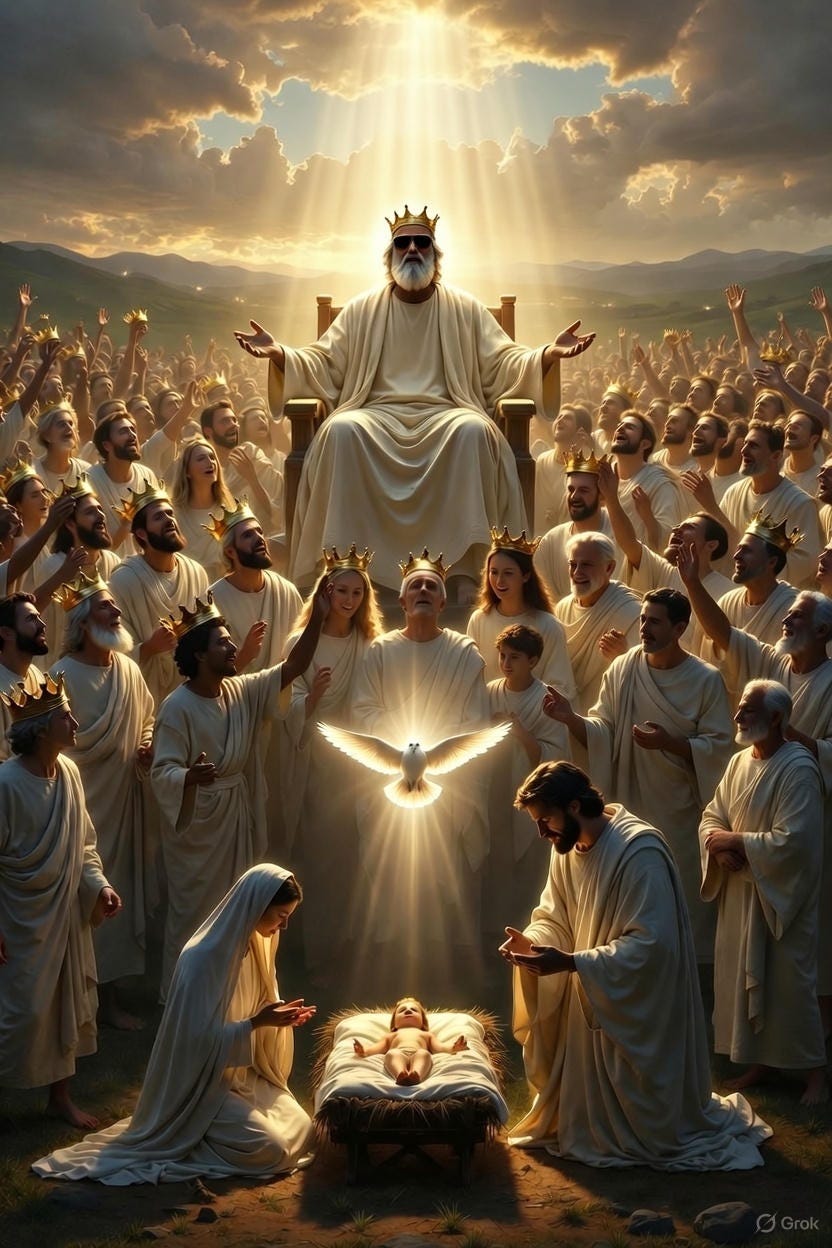
Second, we receive power to show the world whose sons and daughters we really are. The children of an earthly king and queen are set apart, marked, and carry themselves with a royal bearing. Likewise, we should carry ourselves as the heirs of God’s kingdom. Specifically, we stand to inherit in three ways.
First, we are heirs of the earth.
When Jesus, quoting the psalms, says that “the meek shall inherit the earth” (Matthew 5:5, Psalm 37:11), He is not talking about the undeserving poor, vagrants, grifters, tortured souls, starving artists, or a general class of losers.
No. He is talking about His ekklesia, His called-out ones, His Church.
We are meek the way any subject is before his king.
We know our place in the new creation, but we are confident of and sure in that place, knowing that we can never lose it.
Second, we are heirs of the sabbath. The sabbath was the great sacrament of the Old Testament, the outward and visible sign of an inward and spiritual reality: the promised rest of God.
That promise is now fulfilled. The old sabbath is abolished. Now we rest — not on a specific day because our overseer tells us we must, like slaves, only so we’re good for more work tomorrow — now we rest in God, so that He can go to work on us.
Practically, this means when we have done all that we can do, we rest and allow God to determine the outcome.
Do you need money? Then you must work, but rest in God to provide.
Do you need healing? Then you must take care of your body, eat right, seek medical care when needed, but rest in God to heal you.
We don’t need congress to pass more health care subsidies. The government is forever trying to fix and prop up the old creation, the kingdom of death, but the proclamation of Christmas is that the firstborn of the new race of men has come.
This is the next part of the experiment. The sabbath requires us to cast our care on God so that we might have the experience of Him caring directly and personally for us. God’s care and rest are part of our inheritance. The promised sabbath rest of God has arrived in all its power and glory (Hebrews 4:9).
Finally, we are heirs of the law of God.
True, we are no longer under the law. It is no longer our custodian. Instead it has become our trusted friend, a wise counsellor, one who taught us well in our infancy and now continues to guide us because, “In the beginning was the Word, and the Word was with God, and the Word was God.”
No word of God ever becomes void. It must always be fulfilled. We are heirs to all that the law promised: justice, the right worship of God, the right ordering of family life, and the right ordering of society.
Far from being a dead letter, or something that no longer applies to Christians, Christians are to apply God’s law to the nations, to bind sinners and to release those held captive by sin.
God’s law remains the only God-given plan we have for the self-government of free men.
This is the final component of the experiment: freed from the law’s constraints, are you now willing to apply God’s law both to the original creation mandate to subdue the earth and to the new creation mandate to disciple the nations?
To be a Christian means you can give credible evidence that you are, that the power of God is active in your life, both in the confidence in which you proclaim your faith, and in your boldness in applying God’s word to all of life.
Christian power — the power of Christians — should be evident in every family, town, state, and nation.
Preached on December 28, 2025, at the First Congregational Church, Woodbury, Connecticut (https://www.firstchurchwoodbury.org).


