

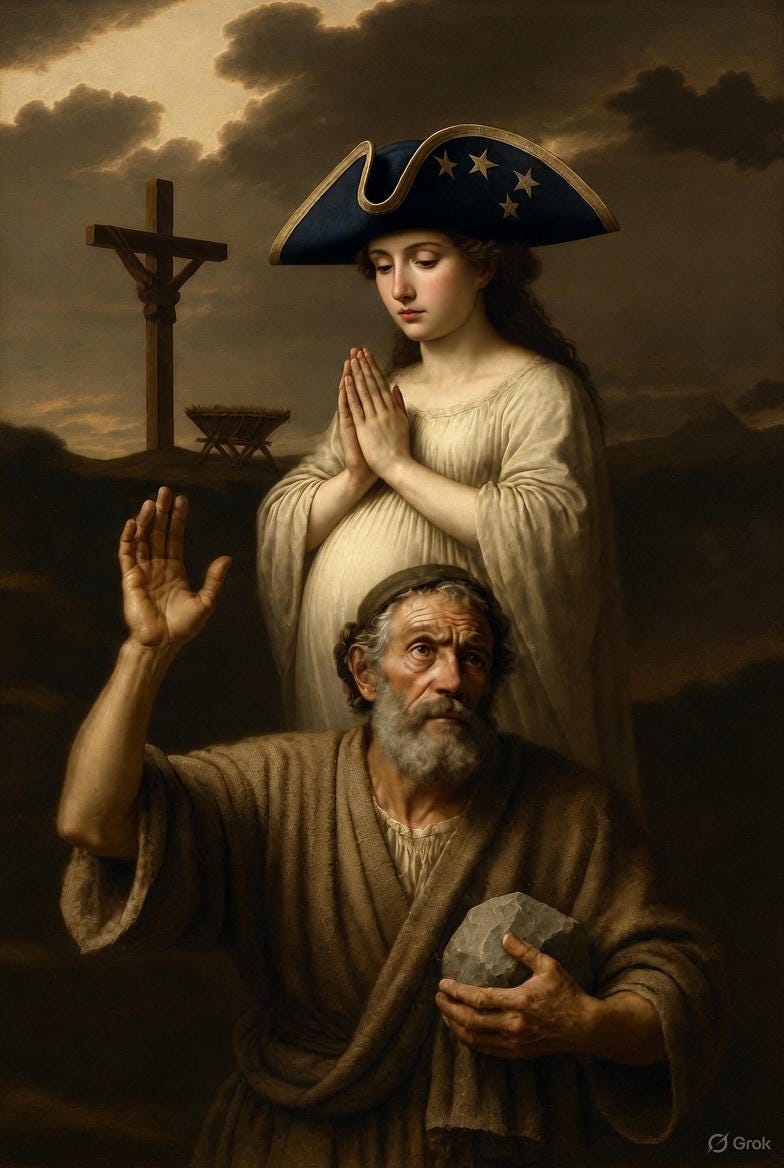
We love the gentle virgin mother at Christmas—yet her pregnancy looked like the result of adultery deserving death. Mary chose courageous silence, trusting God to vindicate her. Joseph learned restraint. We, however, stay shamefully silent while evil festers and innocent blood cries out.
But God refuses our quiet compromise. He gives us the sign of the Virgin and the counsel of Emmanuel, calling us to an obedience that may cost us comfort—yet promises hope.
This Sunday, hear how the God who reigns over nations offers renewal to a spoiled Connecticut vine and a judged people facing 2026. Emmanuel is with us—and His face will shine again.
Advent 4
Psalm 80; Isaiah 7:10-16; Romans 1:1-7; Matthew 1:18-25
You can also subscribe to this podcast on Apple, Spotify, or YouTube.
I.
There is a problem in our texts this morning from Isaiah and Matthew. It is not the problem that the scientific atheist tends to raise, which is that, to his limited way of thinking, the virgin birth is a silly, impossible, unscientific idea. That is not the problem at all.
Rather, the problem is that, according to the Law of Moses, Mary should have been stoned to death for adultery. Why wasn’t she?
Deuteronomy 22:22-23 reads:
“If there is a betrothed virgin, and a man meets her in the city and lies with her, then you shall bring them both out to the gate of that city, and you shall stone them to death with stones, the young woman because she did not cry for help though she was in the city, and the man because he violated his neighbor’s wife; so you shall purge the evil from the midst of you.”
By the time the events recounted in our reading from Matthew this morning take place, this penalty had been forbidden to the Jews by the Romans.
One of the things that marks an oppressed people is that they are stripped of legal standing and their law and customs are proscribed, if not outright forbidden. In Jesus’ day, only the Roman governor could execute a sentence of death and that by crucifixion.
Crucifixion, handing, beheading, firing squad, electric chair, lethal injection — these are all state-executed means of imposing death.
Stoning was communal justice and communal execution of punishment.
That is why Joseph himself could not (and therefore did not) pick up the first stone and cast it at Mary. By Joseph’s day, justice had been denied to the Jews for a long time.
Matthew 1:19 tells us that Joseph was a just man. This means he kept the law of God and that he was zealous to put that law to good use. He was zealous to use it as the God-given tool to purge the evil from among his people.
Do we think of the law that way, as a God-given tool, as a God-given tool to remedy evil?
As a just man, Joseph’s thinking went something like this: Moses, the divinely-appointed law-giver, understood that sin is inherited, so the law should be used to remove the criminal element from society by putting it to death.
This mirrors God’s own sentence of death, solemnly pronounced in Genesis 2:17, “but of the tree of the knowledge of good and evil you shall not eat, for in the day that you eat of it you shall die.”
One of the great evils in every age, including our own, is sexual sin. Therefore, the law required the death penalty for sexual immorality: sodomy, fornication, adultery, bestiality.
The law ensured that not only the adulterers, but the offspring of their adultery were removed from society.
The logic here is that adulterers will simply give birth to more of the same, that sinners give birth to sinners.
Now, let us not for a moment think the law of God is cruel and barbaric, or that we have somehow discovered in our own day a higher, more humane law. Our own laws apply the same means — the death penalty — to innocent unborn children, but for very different ends.
Children with undesirable traits, including being conceived at an inconvenient time, are “selectively reduced” as the medical professionals put it.
Rather than purge the evil from among us, our modern laws extend the evil among us, such that we all have blood on our hands.
Abortion is one of the great evils that must be purged from among us. Connecticut will never know peace and prosperity until it is.
The combined political, social, ecclesiastical, and economic crisis we are in is not the result of unseen macro forces, but the hammer of God’s judgment falling on our heads.
Joseph was denied access to the biblical means of purging evil — stoning — so Matthew’s gospel tells us that “unwilling to put [Mary] to shame, [he] resolved to divorce her quietly.”
This is not quite as merciful as it sounds, though Joseph was surely motivated by mercy as well as justice.
As his betrothed, Joseph was legally bound to her, responsible for her upkeep, but it seemed to him that she had made herself unfit to become his consummated wife.
Joseph faced carrying all the obligations of having a wife while gaining none of the benefits. Better to resolve the problem quietly — let her become someone else’s problem — than to be responsible for a ruined woman.
It was a bad situation, but one seemingly arranged by God, to fulfill a predetermined sign and to announce His divine counsel for a new age.
II.
Isaiah and Matthew talk about the counsel of God and of our sinful attempts to thwart it in the readings for the Fourth Sunday of Advent.
In Isaiah, King Ahaz of Judah, the southern kingdom, is given the chance to ask God for a sign from God. “Again the Lord spoke to Ahaz, ‘Ask a sign of the Lord your God; let it be deep as Sheol or high as heaven.’”
But Ahaz declines on the grounds of religious piety saying, “I will not ask, and I will not put the Lord to the test.”
Ahaz is quoting Deuteronomy 6:16, which is the same chapter and verse that Jesus quotes when Satan tempts Him in the wilderness.
King Ahaz exhibits classic religious behavior: he is pious on the outside but rotten on the inside, despising God’s word in his heart. He quotes Scripture, but he perverts its meaning.
In today’s reading from Matthew, Joseph discovers that Mary is pregnant. Then, as now, there is only one ordinary way that can happen, and Joseph knew he wasn’t involved.
Mary’s guilt could be legally proven, because she did not cry for help. Deuteronomy 22 says that such a woman shall be stoned “because she did not cry for help though she was in the city.”
You might be thinking this sounds unfair, but Psalm 19 tells us that the “law of the Lord is perfect.” Therefore, we must not judge God’s law, rather we are to be judged by it.
At the very least, we owe it to the Word of God to understand what it says and what it means.
What Moses meant is that the woman’s silence is evidence of her consent to the adultery. This is because she is “in the city” — meaning she is in close quarters; there are plenty of people around to hear her struggle — and if she won’t put up a fight, then her impure motive and consent to sin must be assumed.
The following verses in Deuteronomy 22:25-27, make the intent of the law clear:
“But if in the open country a man meets a young woman who is betrothed, and the man seizes her and lies with her, then only the man who lay with her shall die. But to the young woman you shall do nothing; in the young woman there is no offense punishable by death, for this case is like that of a man attacking and murdering his neighbor; because he came upon her in the open country, and though the betrothed young woman cried for help there was no one to rescue her.”
We know from Luke 1:26-27 that Mary was in a city when she conceived Jesus.
Luke writes, “In the sixth month the angel Gabriel was sent from God to a city of Galilee named Nazareth, to a virgin betrothed to a man whose name was Joseph, of the house of David; and the virgin’s name was Mary.”
Therefore, the first case of the law applies. Mary was in a city. She did not scream. In fact, we know from Luke 1:38 what her exact words were to the angel Gabriel were.
She said: “Behold, I am the handmaid of the Lord; let it be to me according to your word.”
In other words, she gave her consent.
This took extraordinary courage on Mary’s part. It shows that Mary had faith that God would put things right.
The sign of Mary’s faith was her obedient silence — she did not scream — when screaming was all she needed to do to prove her innocence.
Joseph sought to remedy the situation legally and mercifully, by divorcing Mary quietly. But divorce was not in God’s counsel.
Instead, God gave Joseph a sign. It is the same sign God promised King Ahaz: “Behold, a virgin shall conceive and bear a son, and his name shall be called Emman′u-el.”
By this sign, the marriage of Mary and Joseph could proceed. The sign of the Virgin is enough for Joseph. This same sign is enough for all of us to know Christ as our Savior.
Signs in the Bible — the rainbow after the flood, circumcision after God’s promise to Abraham, or the manner in which Jesus was conceived — all precede the counsel of God. Ahaz rebuffs God’s counsel; Joseph is obedient to it. God’s counsel is more than His good advice. It is His decree, His law, His will. God’s counsel will not fail to achieve its purpose, whether we obey it or not. Human sin is no obstacle for God.
God’s counsels follow God’s signs. In this case His counsel is “his name shall be called Emman′u-el (which means, God with us).” It is God’s will to dwell with us by means of this sign.
St. Paul writes in today’s reading from Romans 1 that he received “grace and apostleship to bring about the obedience of faith for the sake of his name among all the nations.”
The obedience of faith — exemplified by Mary’s silent obedience — is what the Church is called to bring about in our own day.
Our mission and purpose has not changed since Paul wrote those words. Our job is to implement the counsel of God, teaching the nations to obey God.
III.
The Church has largely lost sight of this mission. Like King Ahaz, she refuses to ask for a sign, or, like Joseph, she tries to deal quietly with the signs God gives her.
The terms of God’s offer to give a sign to Ahaz were generous. Isaiah writes, “Ask a sign of the Lord your God; let it be deep as Sheol or high as heaven.”
In other words, no sign is too high or too low for God. But Ahaz refuses to ask God for a sign — “I will not ask, and I will not put the Lord to the test,” he says.
He says this not out of pious respect for God, but because he does not want to accept the counsel of God that comes with the sign.
God has rejected Ahaz’s treaty with the Assyrians. That is the historical context of Isaiah’s prophecy. “Trust Me, instead,” God says to Ahaz. That is counsel from God that Ahaz refuses.
The angel of the Lord says to Joseph in a dream: “Behold, a virgin shall conceive and bear a son, and his name shall be called Emman′u-el (which means, God with us).”
God has chosen Joseph to be foster-father to the Messiah. In contrast to Ahaz, this is counsel that Joseph learns to accept.
But not before Joseph’s attempt to divorce Mary nearly perverted the entire meaning of God’s law. The law is meant to purge evil, not handle it discreetly, which is what Joseph tried to do.
“Joseph, being a just man and unwilling to put her to shame, resolved to divorce her quietly.”
Too often the Church is unwilling to put sinners to shame, and would rather deal with sin quietly, or not at all.
Our mandate is the same as Paul’s: to “bring about the obedience of faith for the sake of his name among all the nations.”
This is as much a call to reformation as it is to evangelism.
Yes, the Church must evangelize, but she must also bring the nations into obedience, obedience to God’s word.
But we refuse this counsel of God because it is too hard, and it makes us unpopular.
We like the sign well enough — Mary, the virgin mother mild — but we lack her obedience to the counsel that comes with it: “she will bear a son, and you shall call his name Jesus, for he will save his people from their sins.”
For the sake of that Name and for the sake of their salvation, Paul and the early church worked tirelessly to put the nations to shame, to convict them of their sins, and to bring about their obedience.
Can the Church in our day truly say to herself that she is called to do anything less?
We must use the law of God. We must use it as the God-given tool to put the nations to shame, to bring them to the cross, so that they might be saved.
In some traditions, Mary is called the icon of the Church, a symbol of the obedience the Church owes to the counsel of God, exemplified by her willingness to be put to shame for the sake of the truth she carries in her.
Let us remember that the next time people scoff at the Church.
IV.
Here’s the thing about evil. If we won’t use the law of God to purge the evil from us, it will fester and grow and ultimately destroy us. Sin is always its own punishment.
Evil destroys the very heart of the law. Sin doesn’t confine itself to the bedrooms of consenting adults. The womb doesn’t hide the murder that takes place in the dark. When the very earth opens her mouth to drink the blood of innocents, mother nature does not stay quiet. She cries out for vengeance.
Evil calls down the wrath of God. There is no turning a blind eye to it. Live and let live is not an option. Libertarianism fails for this reason and amounts to cowardice in the face of the Enemy. Christians cannot be libertarians.
The Church that is silent while evil spreads in her congregations like wildfire isn’t loving her neighbor. She is not serving her city. This is one time when silence is violence. The Church’s shameful silence in this dark December hour truly does equal death.
But the One who saves us from this judgment is coming to dwell among us. We know Him by the sign of the Virgin.
The violence done to Christ by wicked men from among His own people — a nation long under God’s judgment — is acceptable to God and becomes the means of eternal life for those He came to save.
Paul says all this was “promised beforehand through his prophets in the holy scriptures.” It was all part of the counsel of God from the very beginning.
Will we accept the counsel of God? Are we going to continue the labors of Paul and all the apostles to bring about the obedience of the nations to the name of Jesus? Is this how we will spend the year to come? Or do we have better things to do in 2026?
V.
Let me conclude by returning to the examples of Ahaz and Joseph, how the one rejected and the other accepted the sign and counsel of God.
The application for us and our lives as we head into 2026 is that the law, even the law of God, must never be used by us in a vain attempt to bind God and thwart His divine counsel.
King Ahaz tried to do that. “I will not ask, and I will not put the Lord to the test,” he said, citing the Law of Moses.
That did not keep God from announcing the sign of the Virgin through His prophet, Isaiah, and from fulfilling that sign centuries later when Mary conceived.
Ahaz sought to limit God. He sought to limit God using God’s own law against Him. Instead, God set a limit on Ahaz and his kingdom.
On the other hand, Joseph showed that he could follow the guidance of the Holy Spirit, first by showing restraint in his response toward Mary, and second by his obedience to God’s counsel given in the heaven-sent dream, when he was visited by the angel of the Lord.
Joseph’s restraint and obedience left room for God to act. Joseph knew he could not bind God. In the coming year, how can we leave room for God to act and avoid foolishly trying to bind His will?
First, we must not resist the counsel of God — even if it’s hard, even if we are put to shame. The whole message of the Bible is that God’s people will soon be vindicated. Like Mary, we must magnify the Lord, without counting the cost.
Second, we must follow Joseph, not Ahaz. Ahaz made pious excuses for not accepting the counsel of God.
I hear Christians make pious excuses for not voting, for not getting involved politically, for not supporting a candidate because they doubt his salvation or if he is born again.
I have heard Christians say they will not vote for someone because he is a Catholic, or because he is not an abortion abolitionist.
These tests of purity need to stop. We are making the perfect the enemy of the good. This is Ahaz-thinking, not Joseph-thinking.
Our task is to heed the signs of the times and obey the counsel that comes with them.
God is about to act. Let us not be found opposing Him when He does (Acts 5:39).
The new year may bring new signs and fresh counsels from God.
250 years ago, the Spirit of ‘76, was the sign the Christian men of Connecticut and the other colonies needed to organize and fight for independence. They fought for home rule and self-government.
Home rule and self-government are under attack in this state, especially after the special session last month.
The Spirit of ‘76 was the sign, and the Declaration of Independence was the counsel. The counsel was this: the rights of free men are given to them by God. They are not privileges granted by the State to keep us enslaved or as a reward for our compliance.
As the calendar turns to 2026, we enter our 250th year as a nation, as a people. Let us not weary God with our quiet complacency, our black-pilling, and our hopelessness. Such are the signs and counsels of Satan.
Our Lord has come, under the sign of the Virgin. He is Emmanuel. He dwells with us and reigns over us from His throne in heaven.
He governs His people and orders the affairs of all nations. He casts down the mighty from their thrones and exalts the humble and meek.
May 2026 be a year of casting down and lifting up. May this vine called Connecticut, defenseless and spoiled, be saved when His face shines once more.
Preached on December 21, 2025, at the First Congregational Church, Woodbury, Connecticut (https://www.firstchurchwoodbury.org).


